
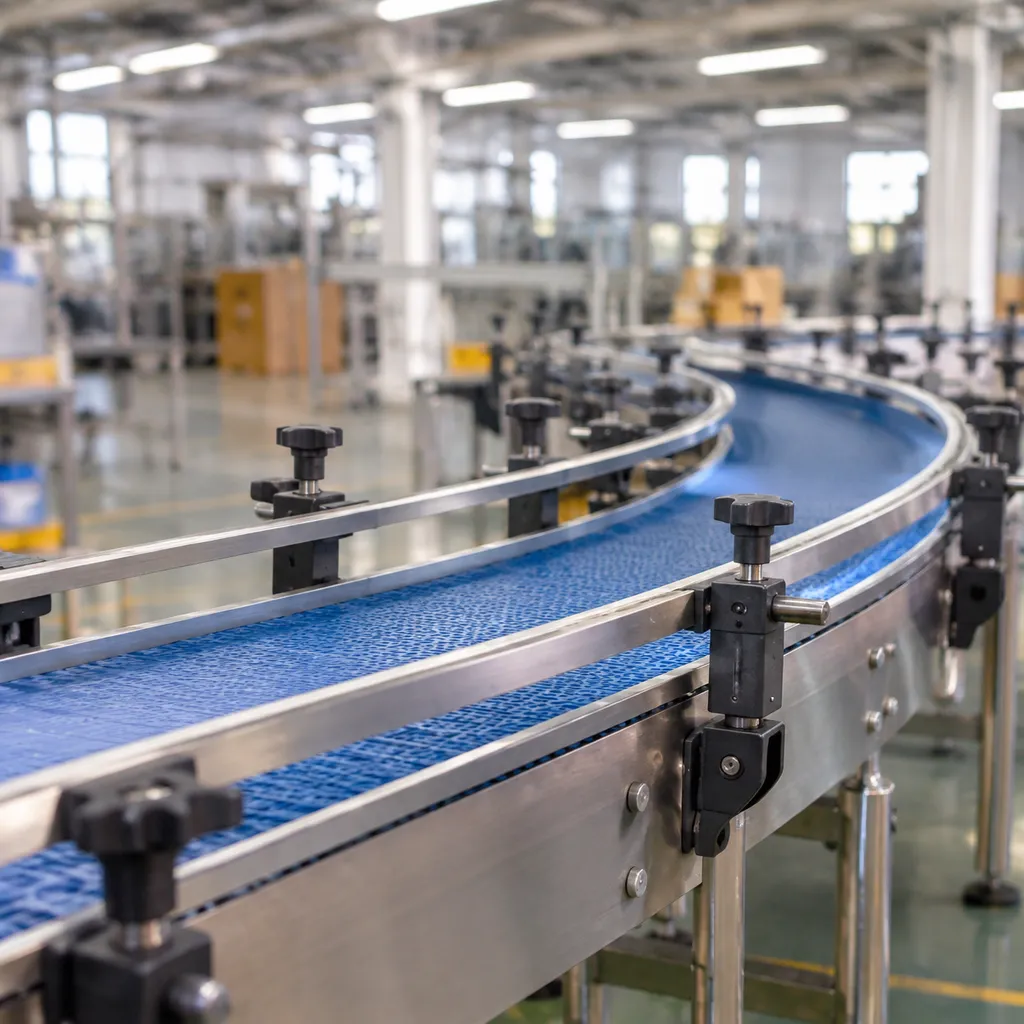
The Role of Conveyor Systems in Food Processing
Conveying technology serves as the operational backbone of modern industrial facilities, moving materials through processing stages with speed, precision, and consistency. In the food sector, these systems do more than transfer raw ingredients and finished goods; they establish the flow, pacing, and baseline sanitation of the entire production line. Choosing and configuring equipment based on a comprehensive conveyor guide ensures operations maintain high throughput while upholding uncompromising quality standards.
Why Conveyors Are Essential for Modern Food Production
Automated material handling transforms food manufacturing by eliminating bottlenecks and standardizing product movement. Implementing dedicated food-grade conveyor systems delivers measurable production advantages:
- Continuous Throughput: Moves goods seamlessly through sorting, thermal processing, freezing, and packaging without manual intervention.
- Labor Optimization: Reallocates workforce resources from repetitive transport tasks to quality control and equipment operation.
- Product Integrity: Reduces human contact, impact damage, and product loss across delicate or irregular items.
- Line Synchronization: Accurately paces the transfer of items to match downstream machinery, such as wrappers, checkweighers, and palletizers.
Conveyor System Design as a Critical Food Safety Decision
Conveyor architecture directly influences sanitation performance, audit outcomes, and consumer protection. Equipment engineering must prioritize hygienic design principles to mitigate biological, chemical, and physical contamination risks.
| Design Focus | Engineering Requirement | Operational Impact |
|---|---|---|
| Surface Topography | Smooth, non-porous contact surfaces | Prevents organic buildup and bacterial adhesion |
| Structural Geometry | Sloped surfaces and tubular or open framing | Facilitates liquid runoff and prevents pooling |
| Accessibility | Tool-less disassembly and quick-release components | Ensures complete access for sanitizers and inspections |
| Material Compatibility | Corrosion-resistant, inert plastics and metals | Eliminates chemical degradation during washdowns |
Treating conveyor selection as an active food safety decision protects brand reputation and prevents cross-contamination throughout the manufacturing lifecycle. Engineered drainage, crevice-free welding, and compliant food-contact materials work collectively to maintain a sterile processing zone and streamline plant-wide sanitation procedures.
Key Benefits and Hygienic Design Features
We build food-grade conveyor systems to prevent contamination, eliminate product loss, and ensure smooth line operation. Every detail, from the main frame down to the wear strip, must support strict sanitation routines without trapping food particles or harbor bugs.
Why Stainless Steel Construction Matters
In food plants, equipment handles harsh chemical washdowns, high temperatures, and constant moisture. We rely on premium stainless steel conveyors to keep lines running without pitting, corrosion, or structural fatigue.
Pairing a sturdy frame with a precision-machined stainless steel chain guide reduces friction, prevents belt drift, and stops metal-on-metal contamination before it starts.
| Feature | Food-Grade Stainless Steel | Standard Carbon Steel |
|---|---|---|
| Corrosion Resistance | Superior against acids, salts, and caustic wash | Prone to rust and flaking |
| Surface Porosity | Non-porous, smooth sanitary finish | Porous; harbors bacteria |
| Cleaning Tolerance | Handles high-pressure washdown and chemicals | Degrades under sanitizing agents |
| Wear Life | Long service life under extreme line cycles | Frequent replacement needed |
Essential Features of Sanitary Conveyors
A dependable conveyor guide setup requires smart hygienic design from top to bottom. We eliminate problem areas where bacteria multiply by focusing on these design essentials:
- Open-Frame Geometry: Round or angled tubular frames shed water immediately and eliminate flat pooling areas.
- Tool-Less Disassembly: Belts, guides, and wear beds remove quickly for deep CIP and manual cleaning.
- Self-Draining Surfaces: All horizontal surfaces carry a minimum pitch to shed liquids during operation.
- Continuous Welds: Fully seal-welded seams prevent crevices, eliminating hidden pockets where organic matter gathers.
- Low-Friction Guides: High-performance plastics paired with steel tracks keep chain conveyors stable and running cool.
Regulatory Compliance and 3-A Sanitary Standards
Food safety regulations are non-negotiable. Our equipment design aligns with FDA regulations and 3-A Sanitary Standards to keep facilities fully compliant during audits.
- FDA Compliance: Materials that contact food—including food conveyor belts and guide rails—meet FDA 21 CFR guidelines for direct contact.
- 3-A Sanitary Standards: Components feature specific surface finishes (Ra values) and ground seams to prevent bacterial adhesion.
- Cleanability Verification: Open access ensures inspection teams verify clean surfaces quickly before daily production restarts.
Common Types of Food Processing Conveyors
Every production line requires a specific approach to material movement. Selecting the right setup prevents line bottlenecks, protects fragile goods, and maintains compliance across the plant. Below are the primary food-grade conveyor systems we rely on across the industry.
Belt and Slat Conveyors
Belt and slat models serve as the backbone of packaging, sorting, and assembly operations:
- Flat Belt Conveyors: Best for moving packaged items, raw dough, and meat cuts along level planes.
- Modular Plastic Belts: Feature interlocking segments that allow rapid drainage and simplified washdown routines.
- Slat Conveyors: Utilize overlapping plates to move heavier, hard-sided containers like cans, jars, and bottles.
To prevent lateral belt drifting and excessive edge wear, integrating a reliable conveyor guide along high-speed transition zones keeps the belt tracking straight under continuous load.
Tubular Drag Cable, Chain, and Disc Conveyors
Enclosed tubular drag systems move delicate bulk solids through sealed pipes, preventing dust emissions and eliminating airborne contamination:
- Gentle Transport: Disc assemblies push dry snacks, coffee beans, and cereals without crushing them.
- Flexible Routing: Tubes route easily around ceiling trusses, tight corners, and vertical drops.
- Reduced Friction: In heavy-duty chain-driven setups, using a dedicated nylon conveyor chain guide lowers wear on drive components and cuts operating noise.
Bucket, Screw, and Vibrating Conveyors
When production requires elevation changes or metering bulk ingredients, these specialized units deliver reliable performance:
- Bucket Elevators: Ideal for vertical elevation changes, using food-safe plastic or stainless buckets to lift dry bulk goods without spillage.
- Screw Conveyors (Augers): Best for moving ground meat, pastes, or viscous materials inside enclosed troughs.
- Vibratory Conveyors: Employ controlled mechanical shaking to gently spread, dewater, or grade fragile potato chips and salad greens without surface abrasion.
Pneumatic and Vacuum Conveyors
Pneumatic and vacuum systems use air pressure differentials to convey bulk dry ingredients through fully enclosed tubing:
- Vacuum Transfer: Pulls powders, flours, starches, and sugar from bulk bags directly into mixers.
- Total Containment: Keeps allergens and fine dust completely sealed away from the surrounding plant air.
- Clean Line Routing: Eliminates external mechanical drives along the conveying run, significantly reducing line maintenance.
Specialized Conveyors for Food Line Applications
Every food processing layout demands targeted equipment to solve specific spatial, inspection, and handling hurdles. In this section of our conveyor guide, we highlight specialized transfer units engineered to protect product integrity and maintain high throughput across demanding environments.
Z-Conveyors and Spiral Conveyors for Elevation
Moving products vertically within a compact footprint requires systems designed specifically to prevent spillages and jamming:
- Z-Conveyors: Feature horizontal-to-incline transitions using cleated, food-grade conveyor belts and corrugated sidewalls to lift bulk products, frozen foods, or snacks between different processing tiers.
- Spiral Conveyors: Provide continuous elevation changes for cooling, proofing, or buffering packaged items while maximizing valuable plant floor space.
- Hygienic Guidance: Low-friction chain tracks and sanitary guides reduce operational strain, ensuring steady elevation without product shifting or surface abrasion.
| Feature | Z-Conveyor | Spiral Conveyor |
|---|---|---|
| Primary Use | Bulk raw ingredient elevation | Packaged goods and ambient cooling |
| Footprint | Moderate, linear incline | Ultra-compact, vertical footprint |
| Belting Style | Cleated and sidewall belts | Continuous modular plastic chain |
Weigh-Station and Metal Detector Conveyors
Quality control sections represent zero-tolerance zones on any packaging or processing line:
- Signal Isolation: Built using non-metallic components and anti-static materials around detection heads to eliminate false readings during inline safety checks.
- Inline Checkweighers: Seamlessly verify unit weights with high-precision load cells and high-speed reject stations, such as air blasts or pneumatic drop gates.
- Sanitary Integration: Open stainless steel conveyors prevent fine powders or moisture from gathering under belts, making inspection stations easy to wash down while meeting FDA regulations.
Heavy-Duty Pallet and 180 Box Conveyors
End-of-line packaging and distribution require heavy-duty performance to manage stacked containers, cartons, and pallet loads:
- 180-Degree Box Turners: Rotate and align cases for proper labeling, taping, and automated palletizer intake without pinching or marking the packaging.
- Pallet Handling: Rugged chain conveyors and motor-driven roller beds handle heavy shock loads at loading docks and staging zones.
- Durable Components: Reliable side rails and low-friction wear tracks reduce motor drag under heavy payloads. Deciding how to choose UHMWPE vs HDPE for strength and wear ensures long-lasting guide surfaces, while consulting a UHMWPE sheet thickness guide for wear and load needs guarantees the right support for structural wear components.
Cleaning, Sanitation, and Maintenance Protocols
Keeping conveyor lines clean is non-negotiable in food production facilities. A thorough conveyor guide for sanitation prevents bacterial growth, safeguards product integrity, and extends equipment service life. When selecting components like wear strips and guide rails, understanding uhmwpe sheet wear issues causes solutions and prevention ensures that washdown procedures do not degrade underlying structural plastics over time.
Manual Cleaning vs. Automated CIP and COP Systems
Food processing facilities balance sanitation efficiency and equipment safety by utilizing distinct cleaning strategies tailored to line layout:
- Clean-in-Place (CIP): Integrated spray manifolds and automated wash cycles sanitize belt loops and frames without major teardowns, significantly cutting downtime on long sanitary conveyors.
- Clean-Out-of-Place (COP): Removable parts—such as wear strips, modular belt pins, and side guides—are disassembled and immersed in dedicated wash tanks for deep agitation and chemical exposure.
- Manual Cleaning: Operators hand-scrub targeted niches, drive assemblies, and sensitive sensors using food-grade foaming detergents and low-pressure rinses.
Establishing Effective Conveyor Sanitation Protocols
A dependable sanitation standard operating procedure (SSOP) protects food safety across every shift:
| Stage | Primary Action | Key Focus |
|---|---|---|
| 1. Dry Clean | Scrape and sweep bulk debris | Eliminate gross soil before introducing moisture |
| 2. Pre-Rinse | Low-pressure warm water flush | Remove residual product films without creating aerosols |
| 3. Detergent Application | Foam-based alkaline or chlorinated cleaners | Penetrate organic proteins and grease on all contact surfaces |
| 4. Post-Rinse | Thorough potable water rinse | Flush chemical residues completely from stainless steel frames |
| 5. Sanitize | Apply EPA-registered no-rinse sanitizer | Neutralize remaining microbes on food conveyor belts |
Validation and Verification with ATP Testing
Visual inspection alone cannot confirm that a surface is biologically clean. We rely on rapid Adenosine Triphosphate (ATP) bioluminescence swabs to verify cleanliness immediately after sanitation cycles. Swabbing critical friction points, underside belt flights, and conveyor guide tracks yields numerical Relative Light Unit (RLU) readings within seconds. Establishing strict baseline pass/fail thresholds allows quality assurance teams to spot cleaning failures immediately, re-clean problem zones before startup, and maintain full compliance with FDA regulations.
How to Choose the Right Food Processing Conveyor Guide

Selecting the proper handling equipment requires matching your mechanical layout directly to your operational throughput and food safety standards. A well-engineered conveyor guide setup ensures smooth product transfers, reduces bottleneck risks, and protects product integrity across high-speed lines.
Evaluating Product Characteristics and Line Capacity
Every food product behaves differently during transport. When sizing equipment and setting line speed, assess physical properties directly against volume targets:
- Product State: Wet, dry, frozen, sticky, or fragile items dictate surface friction and pocket design.
- Operating Speed and Volume: High-speed processing requires rigid tracking and robust lateral control. Installing durable conveyor line guardrail systems keeps containers aligned, prevents product spillage, and protects your line from jams.
- Thermal Conditions: Baking, chilling, and flash-freezing zones demand components that handle extreme thermal expansion without warping.
Selecting Food-Grade Conveyor Belt Materials
Food-grade conveyor systems rely on high-performance polymers and metals that resist chemical breakdown, moisture absorption, and microbial growth.
| Material Type | Core Benefits | Common Applications |
|---|---|---|
| UHMWPE | Extremely low friction, high wear resistance, easy sanitation | Guide rails, wear strips, slider beds |
| Polypropylene (PP) | Chemical resistance, handles hot washdowns, cost-effective | Modular plastic belts, sorting tables |
| Polyethylene (PE) | Performs well in sub-zero and cold-room environments | Freezing tunnels, cold storage transport |
| 304/316 Stainless Steel | Maximum corrosion resistance, high tensile strength | Raw meat, poultry, and washdown zones |
For high-demand bottling, packaging, and raw ingredient transport, using matched conveyor chains modular belts ensures reliable drive engagement and simplified washdown routines.
Balancing Durability, Customization, and Total Cost of Ownership
Initial purchase price represents only a fraction of total conveyor expense. Prioritize modular components that simplify preventative maintenance and lower utility consumption:
- Sanitation Labor: Quick-release parts and tool-less belt removal reduce daily sanitation labor hours.
- Component Lifespan: Engineered plastics minimize friction, cutting motor strain and energy draw.
- Modular Scalability: Interchangeable guides and modular wear components allow fast line reconfiguration whenever packaging sizes change.
Frequently Asked Questions About Food Conveyors
Choosing and operating equipment in modern food plants comes with tough operational questions. In this conveyor guide section, I answer the most frequent inquiries plant managers and line engineers bring to my team about keeping lines running smoothly, safely, and cleanly.
What Is the Most Common Conveyor Type in Food Processing?
Flat belt and modular plastic belt conveyors are the most common systems found in food plants today. Their popularity comes down to straightforward versatility, simple sanitation, and widespread availability of reliable conveyor components designed for washdown environments.
- Modular Plastic Belts: Best for meat, poultry, bakery lines, and tight turns where positive drive sprockets eliminate belt slippage.
- Flat Homogeneous Belts: Ideal for raw proteins and wet processing because non-porous surfaces prevent bacteria from hiding.
- Stainless Steel Wire Belts: Standard for frying, baking, breading, and high-heat continuous ovens.
How Often Should a Food Processing Conveyor Be Cleaned?
Cleaning frequency depends strictly on product risk levels, production run lengths, and food safety regulations:
- High-Risk Zones (Raw Meats, Dairy, Ready-to-Eat Lines): Clean and sanitize thoroughly after every shift, or at least every 4 to 8 hours during continuous runs.
- Dry Processing Zones (Grains, Powders, Snack Foods): Vacuum and dry-wipe daily, with scheduled deep sanitization weekly or during product/allergen changeovers.
- Between Product Changeovers: Immediate wet or dry washdowns are required whenever moving between allergen-containing recipes to avoid cross-contamination.
Maintaining accessible conveyor parts makes teardown quick, helping your sanitation crew achieve target swab results without eating into production hours.
Can One Conveyor Type Handle All Food Products?
No single conveyor design can handle every food category effectively. Fragile snack chips crack inside high-speed bucket systems, fine baking powders clog exposed open-belt rollers, and raw poultry quickly ruins hardware that lacks genuine sanitary washdown construction. Matching line velocity, product moisture, temperature, and cleanability requirements to your specific application is the only proven way to protect product integrity and pass food safety audits every time.