
POM Sheets & Rods
Source POM sheet, acetal rod and drawing-based components for precision mechanical applications. Compare material grades and define the dimensional requirements before moving from stock to finished part.
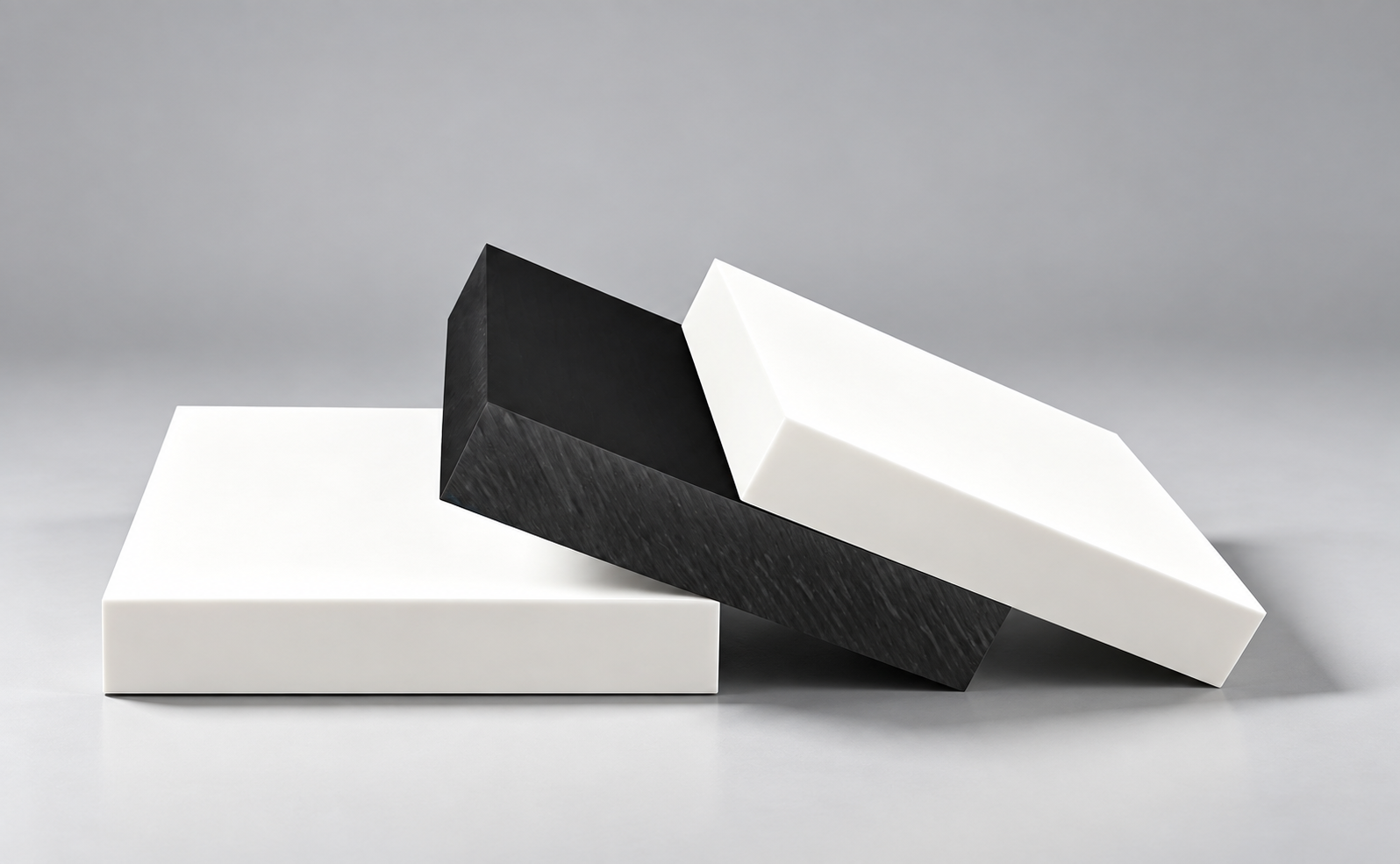
POM sheet, acetal rod or a machined component
POM Sheets
Full sheets and cut blanks for plates, guides, fixtures, blocks and other milled components.
Specify length × width × thickness, grade, color and quantity.
Request POM Sheet Pricing →Acetal Rods
Round stock and cut lengths for turning bushings, sleeves, spacers, rollers and precision round components.
Specify diameter × length, grade and machining allowance.
Request Acetal Rod Pricing →Custom POM Parts
Combine material supply with cutting, drilling, milling and turning based on an approved drawing.
Identify critical fits, inspection conditions and required finish.
Explore Machining Services →Dimensional stability for repeatable component fits
POM combines low moisture absorption with good machinability. This makes it a useful candidate for close-fitting parts, while thermal movement, stock stress and long-term loading still require attention.
Low Moisture Uptake
Lower sensitivity to moisture can simplify fit control compared with more moisture-sensitive plastics such as nylon. It does not eliminate dimensional change.
State humidity, washdown or immersion conditions for grade review.
Temperature & Fit
A part measured in a workshop may fit differently at its working temperature. Allow for thermal expansion and differences between plastic and metal mating parts.
Specify inspection temperature and operating range.
Stress & Machining
Stock manufacture and material removal can influence distortion. Thin walls, deep pockets and uneven sections need process review.
Discuss roughing, stabilization and finishing where geometry warrants it.
Mark critical dimensions, datums, geometric requirements and the permitted clearance. Tolerance capability depends on part size, geometry, grade, process and measurement conditions; it is confirmed after drawing review.
POM-C vs POM-H: understand the difference.
Acetal is another name for POM. Copolymer POM-C and homopolymer POM-H have different property profiles. This guide compares the families; actual supply grade and availability must be confirmed in the offer.
| Selection factor | POM-C — copolymer | POM-H — homopolymer |
|---|---|---|
| General selection focus | Balanced mechanical properties and chemical-resistance requirements | Applications where strength, hardness and stiffness merit comparison |
| Mechanical profile | Assess the exact grade's strength, modulus, fatigue and creep data | Unfilled grades typically show somewhat higher hardness and strength than comparable POM-C |
| Chemical & wet environments | Often favored when chemical resistance is a key comparison factor | Check chemical and hot-water compatibility for the specific grade |
| Precision machining | Both families are used for machined parts. Review stock quality, geometry, dimensional requirements and operating conditions. | |
| Modified grades | Wear-modified, reinforced, conductive or other special formulations require separate grade identification, supply confirmation and supporting data. | |
| Before ordering | Agree grade designation, stock form, datasheet and any required traceability or compliance documents. | |
Specify POM-C or POM-H and the exact material reference when required. Food-contact, electrical and other special requirements must be supported by documentation for the supplied grade.
Define your POM sheet or acetal rod requirement.
| Item | POM sheet | Acetal rod |
|---|---|---|
| Dimensions | Length × width × thickness, mm | Diameter × length, mm |
| Standard supply | Request current sheet sizes and thicknesses for the selected grade | Request current stock diameters and lengths for the selected grade |
| Custom dimensions | Cut panels, blanks, strips and machined shapes | Cut lengths and turned profiles, subject to drawing review |
| Grade & color | Specify POM-C / POM-H, exact grade where required, and color. Availability confirmed in the quotation. | |
| Raw-stock tolerances | Agree thickness, length, width and flatness | Agree diameter, length, roundness and straightness |
| Finished-part requirements | Provide datums, critical tolerances, finish, inspection temperature and mating-component details. | |
| Quantity & delivery | Include trial and repeat quantities and destination. MOQ, lead time, packaging and document availability confirmed before order. | |
From material stock to functional components
Gears & Timing Components
Evaluate machined gears and indexing parts against tooth geometry, torque, speed, lubrication and duty cycle.
Fatigue and wear performance must be assessed for the actual design.
Bushings, Sleeves & Spacers
Use acetal rod as a starting form for round parts with defined diameters, shoulders, bores and mating clearances.
Specify load, speed and operating temperature.
Fixtures, Guides & Handling Parts
Review POM sheet for locating blocks, guides, star wheels and equipment components requiring repeatable geometry.
Identify critical locating faces and the contact material.
Cutting, milling, drilling and turning to drawing
Specify
Send the material, drawing revision and quantity.
Review
Agree stock form, allowance and critical features.
Machine
Cut, mill, drill and turn to the approved scope.
Inspect
Check agreed dimensions and acceptance points.
Deliver
Confirm protective packing and shipment details.
Compare the proposed grade, usable stock dimensions, machining scope, inspection plan and delivery terms together. A material name alone is not enough to define a precision-part order.
POM Sheets & Rods FAQ
Are POM and acetal the same material?
Acetal is a common name for polyoxymethylene, or POM. Specify whether the order requires copolymer POM-C or homopolymer POM-H, plus the exact grade when applicable.
Why is POM considered for precision machined parts?
Low moisture absorption, stiffness and good machinability make POM a useful candidate. The final fit still depends on temperature, geometry, stock condition, machining and loading.
Is POM-C or POM-H better?
Neither is best for every part. Compare mechanical requirements, chemicals, moisture, temperature and the actual grade data before choosing. Supply availability must be confirmed for the required stock size.
What machining tolerance can you achieve?
Tolerances are confirmed after reviewing the drawing, grade, part size, geometry and inspection conditions. Mark critical dimensions and functional fits so they can be evaluated before quoting.
Can you supply POM sheet and acetal rod cut to size?
Cut blanks and drawing-based machining can be reviewed. Provide raw or finished dimensions, machining allowance, grade, color and quantity.
Is all POM suitable for food contact or hot-water service?
No. Suitability is specific to the material grade and conditions of use. State the required compliance and exposure details and request supporting documentation.
General material reference: Ensinger — POM / Acetal. Family-level guidance is not a certification or guaranteed specification for Jincheng-supplied material.
Request POM sheet, acetal rod or machined parts.
Send the dimensions, quantity and application. Add a drawing reference and identify the features that control fit and function.
Request a POM Quote
Please include grade, dimensions, quantity and application.