
Nylon Sheets & Rods
Source nylon sheet, nylon rod and machined components for mechanical applications. Compare PA6 and PA66, account for moisture-related dimensional changes, and specify the material for your actual load and working conditions.
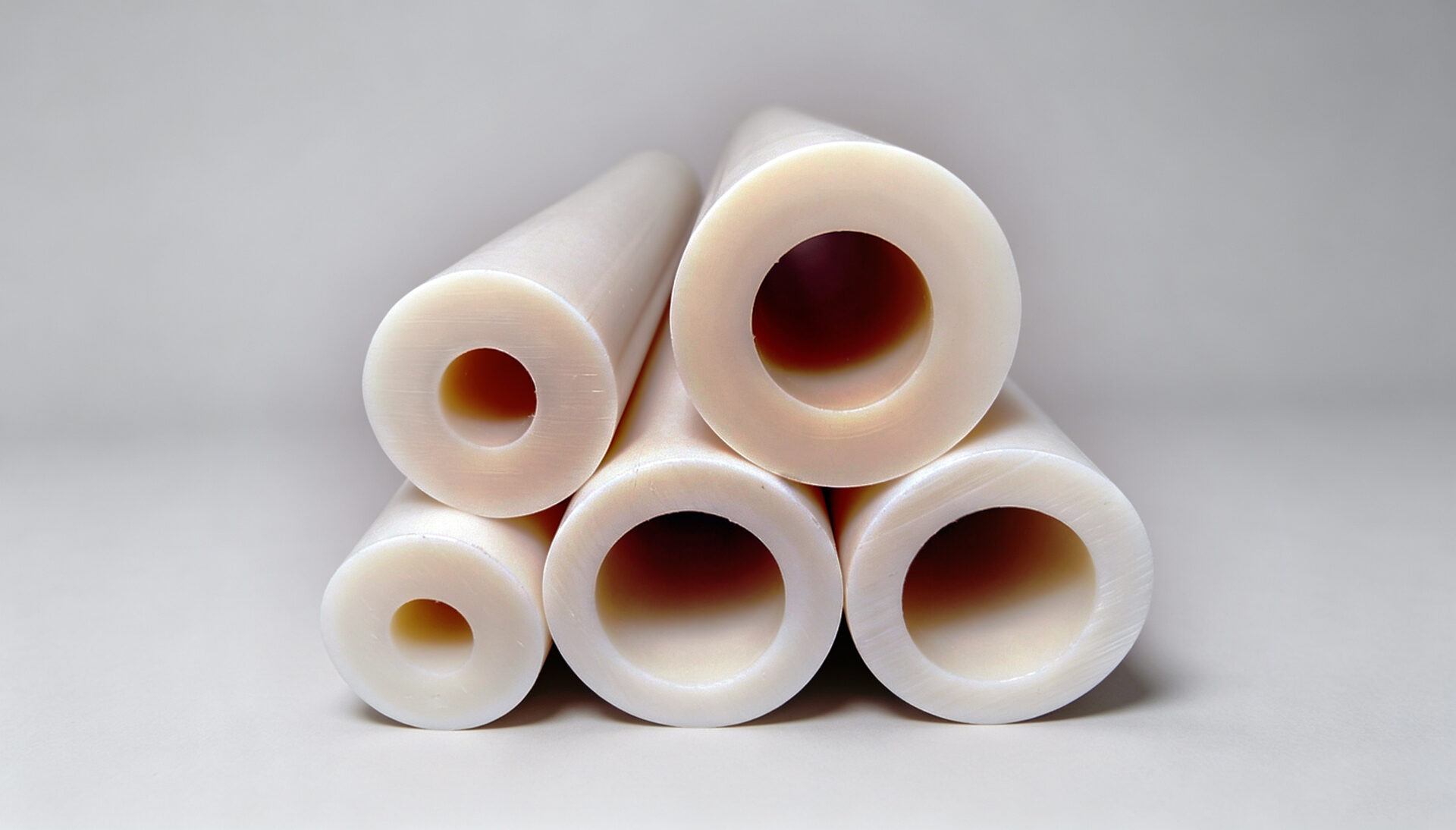
Nylon sheet, rod and finished components
Nylon Sheets
Sheet stock and cut blanks for machined plates, wear pads, blocks and equipment components.
Specify length × width × thickness, grade, color and quantity.
Request Sheet Pricing →Nylon Rods
Round stock for turning bushings, sleeves, rollers, spacers and other cylindrical components.
Specify diameter × length, grade, allowance and quantity.
Request Rod Pricing →Machined Nylon Parts
Cutting, drilling, milling and turning to an approved drawing, with critical dimensions reviewed before production.
Explore Custom Processing →PA6 vs PA66: compare the exact grade.
PA6 and PA66 are different polyamide families. The following is a selection guide; the quotation must identify the exact material grade, production route and datasheet. Availability is confirmed for the requested stock size.
| Selection factor | PA6 nylon | PA66 nylon | What to check |
|---|---|---|---|
| Typical selection focus | General mechanical parts where toughness, wear behavior and machinability matter | Applications where stiffness, mechanical strength and heat performance merit closer comparison | Compare actual grade values at the service temperature and moisture condition |
| Production route | Extruded PA6 and cast PA6 are distinct stock-material options | Specify the actual PA66 stock grade and supply route | Do not treat cast and extruded data as interchangeable |
| Moisture response | Absorbs moisture; dimensions and mechanical properties can change | Also absorbs moisture; dimensional change remains a design consideration | Compare identical test conditions; do not assume a universal absorption ranking |
| Load & wear | Assess contact pressure, creep, impact and sliding conditions | Assess the same factors using the proposed grade's data | A tensile-strength value alone is not a permissible working load |
| Modified grades | Fillers and lubricants can change stiffness, wear, machining behavior and mating-surface compatibility. | Request written confirmation of grade availability and supporting documentation | |
Include PA6 or PA66, cast or extruded where relevant, the supplier grade reference and the condition in which the part will be inspected. A color is not a grade designation.
Moisture absorption can change the fit.
Nylon absorbs moisture from its surroundings. As moisture content changes, the part can grow and its stiffness and strength can change. Time, temperature, humidity, wall thickness and immersion conditions all affect the response.
Humidity & Water Exposure
Describe dry indoor use, humid air, washdown, splash or continuous immersion. These are different operating conditions.
Do not substitute a 24-hour water-absorption figure for equilibrium moisture content.
Clearance & Fits
Check shaft/bushing clearances, guide spacing, press fits and assembly constraints at the expected service condition.
Use the grade's dimensional-change data rather than converting moisture mass uptake directly into linear growth.
Conditioning & Inspection
Agree whether the component is inspected as-machined, dry or conditioned, and specify measurement temperature.
For sensitive fits, discuss stabilization, conditioning and machining sequence before production.
Define the inspection condition and the permitted in-service clearance. If a tight tolerance must hold across large humidity changes, request an assessment of alternative materials as well.
Choose nylon for the load, not just the part name.
Bushings & Sleeves
Provide shaft diameter, bearing length, radial load, rotation speed, lubrication and required clearance.
Review frictional heating, pressure–velocity limits and moisture expansion.
Discuss a Turned Component →Rollers & Wheels
Provide load per wheel, contact geometry, speed, duty cycle, shock loads and axle support details.
Check deformation, contact stress and service temperature for the exact grade.
Explore Conveyor Components →Wear Pads & Sliding Blocks
Provide contact area, load duration, sliding speed, mating surface and installation constraints.
Review long-term creep and wear; short-term strength is not a continuous-load rating.
Review a Machined Part →Permissible load depends on geometry, time, temperature, moisture, speed and acceptable deformation. Request an application-specific review and validate critical components in the intended assembly.
Sheet & rod dimensions and material requirements
| Item | Nylon sheet | Nylon rod |
|---|---|---|
| Dimensions | Length × width × thickness, mm | Diameter × length, mm |
| Standard stock | Request current sheet sizes and thicknesses for the selected grade | Request current rod diameters and lengths for the selected grade |
| Grade | Specify PA6 / PA66 and cast / extruded where relevant; exact grade and supply availability confirmed in the offer | |
| Color & surface | State the required color, visible faces, finish and any mating-surface requirements | |
| Custom size | Cut panels, strips, blanks and machined shapes | Cut lengths and turned profiles, subject to drawing review |
| Tolerances | Thickness, length, width, flatness and critical features by agreement | Diameter, length, roundness, straightness and critical features by agreement |
| Inspection condition | Agree moisture condition, measurement temperature and acceptance criteria | |
| Quantity & delivery | Provide trial quantity, expected repeat demand and destination. MOQ, lead time and packing confirmed in the quotation. | |
Cutting, milling, drilling and turning
Send the latest drawing revision with finished dimensions and critical tolerances. We review the material, blank allowance, machining route and inspection requirements together.
Material
Confirm the exact nylon grade and stock form.
Blank
Prepare sheet or rod with machining allowance.
Machine
Cut, mill, drill or turn to the approved specification.
Condition
Agree any stabilization or conditioning requirements.
Inspect
Check agreed dimensions in the specified condition.
Nylon Sheets & Rods FAQ
What is the difference between PA6 and PA66?
They are different nylon families with different property profiles. PA66 is often considered where stiffness and heat performance matter, while PA6 is widely used for general mechanical components. Compare the exact stock grades, production routes and moisture conditions before selecting.
Will a nylon rod or sheet change size after machining?
It can. Moisture uptake, temperature changes and machining-related stress release can affect dimensions. Define service conditions, inspection conditions and permitted clearance before ordering a precision part.
Does PA66 always absorb less water than PA6?
No universal ranking should be assumed across all stock grades and production routes. Compare the same test method, temperature, exposure duration and conditioning state for the actual materials.
Can nylon be used for load-bearing components?
Nylon can be evaluated for bushings, wheels, rollers and sliding components. Suitability depends on load, contact area, speed, time, moisture and temperature. An application-specific assessment is required.
Do you supply nylon sheet and rod cut to size?
Cut blanks and drawing-based machining can be reviewed. Send dimensions, quantity, grade and critical tolerances. Stock combinations and non-standard requirements are confirmed before order.
What documents should I request?
Request the exact grade datasheet, material identification and available inspection records. Agree test methods, conditioning state and any required compliance documents before purchase.
Material selection references: Ensinger: Polyamide · Mitsubishi Chemical Group: Nylons. General engineering guidance, not certification of Jincheng-supplied material.
Discuss your nylon sheet, rod or machined part.
Share dimensions, quantity and operating conditions. We can review the proposed material and processing route before quoting.
Request a Nylon Quote
Please include grade, dimensions, quantity and application.