
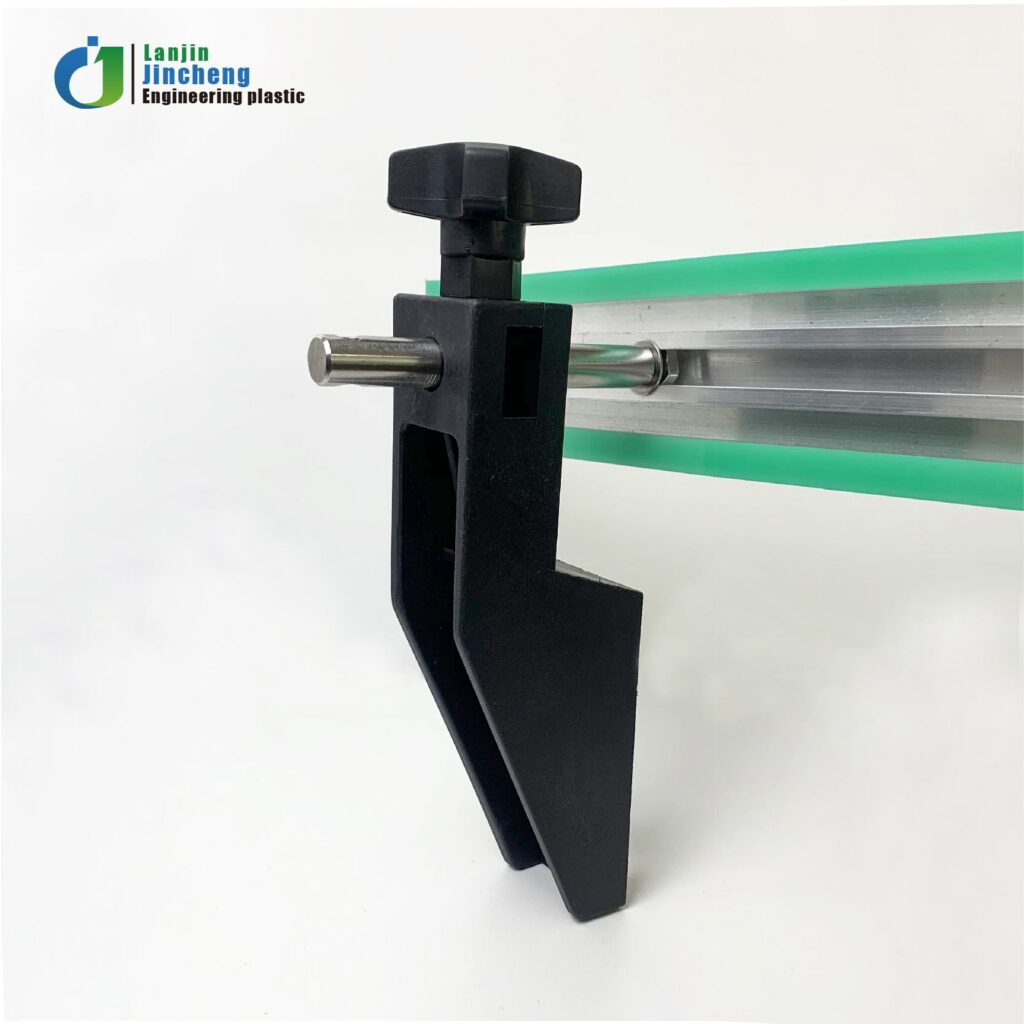
Are you struggling to keep your production line running smoothly due to misaligned products or inconsistent flow? Selecting the right Conveyor Guide Rail Brackets and Mounting Hardware is often the difference between a high-efficiency system and constant downtime.
As someone who has spent years optimizing facility layouts, I know that your choice of fixed, adjustable, or swivel brackets directly dictates your operational flexibility. In this guide, I’m cutting through the technical noise to show you exactly how to match the right clamps, wear strips, and T-slot framing to your specific load requirements.
Whether you’re retrofitting an existing line or building from scratch, this is the blueprint for getting your guide rail setup right the first time. Let’s dive in.
Overview of Conveyor Guide Rail Brackets and Mounting Hardware
Role of Guide Rail Brackets in Conveyor Systems
Conveyor guide rail brackets serve as the structural backbone of any automated transport system. Their primary function is to maintain precise alignment and stability of guide rails, ensuring that products move along the conveyor path without tipping, jamming, or shifting. By providing a secure mounting interface, these brackets allow for the consistent positioning required in high-speed bottling, packaging, and food processing lines. The reliability of these supports directly impacts the operational efficiency and throughput of industrial conveyor systems.
Key Components: Brackets, Clamps, Wear Strips, and Framing
A robust conveyor setup relies on the integration of several critical components to maintain performance under industrial stress:
- Guide Rail Brackets: The primary structural supports that connect the rail system to the conveyor frame, often featuring reinforced Polyamide (PA) or Stainless Steel (SUS304) construction for high strength.
- Cross Clamps: Modular hardware that allows for 2D or 3D adjustments, enabling engineers to fine-tune the height, angle, and horizontal position of the guide rails.
- Wear Strips and Slide Rails: Low-friction surfaces mounted to the rails to protect the product and the guide rail material during high-speed contact.
- Mounting Hardware: Standardized fasteners and support rods that ensure a rigid connection, designed to withstand the persistent vibration and mechanical load typical of industrial manufacturing environments.
By utilizing high-quality reinforced plastic and corrosion-resistant steel, these components offer a durable solution for demanding environments, ensuring long-term stability and minimal maintenance.
Types of Conveyor Guide Rail Brackets
Selecting the right support structure is essential for maintaining line stability. At Jincheng Plastic, we provide a variety of conveyor guide rail brackets engineered to meet the specific mechanical demands of your production environment.
Fixed Guide Rail Brackets
Fixed brackets provide a stable, non-moving mounting point for conveyor side rails. These are ideal for applications where product width remains constant, such as standardized bottling or packaging lines. Constructed from reinforced polyamide or stainless steel, these components ensure that guide rails remain perfectly aligned under continuous operational pressure, preventing vibration and misalignment during high-speed transport.
Adjustable Guide Rail Brackets
For production lines handling multiple product sizes, our adjustable guide rail brackets offer the versatility needed for quick changeovers. These brackets are designed for 2D or 3D adjustment, allowing operators to modify the height, width, and position of the guide rails with minimal downtime. By incorporating robust adjustment mechanisms, these supports maintain rigid positioning while allowing for the precise lateral movement required to accommodate different bottle or package dimensions.
Swivel and Articulating Brackets
Swivel and articulating brackets provide enhanced flexibility for complex conveyor layouts. These components allow for angular adjustments, enabling guide rails to follow curved conveyor paths or accommodate non-standard belt geometries. By using high-strength hardware that supports multi-axis rotation, these brackets ensure smooth product transition and consistent contact points, which is critical when using specialized chain guide rails to manage product flow across intricate sections.
Essential Mounting Hardware and Structural Components
Guide Rail Clamps and T-Slot Framing
We provide essential hardware to secure conveyor guide rail brackets to the frame, ensuring long-term structural integrity. Our robust guide rail clamps are designed to interface seamlessly with standard T-slot framing, allowing for secure positioning without compromising the stability of the conveyor system. By utilizing high-strength materials, these clamps maintain consistent pressure against the rail profile even under high-speed production demands.
Adjustment Knobs, Handwheels, and Fasteners
Precision is critical in packaging and bottling lines. Our range of adjustment knobs and ergonomic handwheels enables operators to make rapid, accurate changes to the guide rail position. These components are engineered for durability, featuring:
Corrosion-resistant materials suitable for wash-down environments.
Secure locking mechanisms to prevent vibration-induced movement.
Easy-grip designs that facilitate quick, tool-free adjustments during product changeovers.
Side Guides, Wear Strips, and Slide Rails
To maintain smooth product flow, side guides and wear strips are vital in reducing friction and protecting your conveyor hardware. When managing high-load applications, addressing UHMWPE sheet wear issues is essential to extending the life of your slide rails. We focus on providing high-performance materials that minimize surface drag, ensuring that items move efficiently along the conveyor while preventing premature degradation of the guide rail system.
Adjustment and Installation Best Practices
How to Adjust Guide Rails for Different Product Sizes
Proper adjustment of conveyor guide rail brackets ensures smooth product transition and prevents line jams. When managing various bottle or package sizes, your focus should be on maintaining consistent clearance and parallel alignment relative to the conveyor belt. Using modular brackets allows for rapid width modifications without dismantling the entire structural framework.
| Adjustment Type | Recommended Action | Goal |
|---|---|---|
| Width Offset | Loosen the cross clamp and slide the bracket along the support rod | Match container diameter precisely |
| Height Position | Adjust the vertical mounting point on the frame | Center the rail against the product profile |
| Angle Alignment | Pivot the bracket head to match curved sections | Ensure uniform pressure on product sides |
Mounting Alignment on Conveyor Frames and Stands
Precise installation is the foundation of a reliable conveyor system. We recommend verifying the mounting interface on your conveyor beam hardware before securing the brackets. Ensure that all support rods are perpendicular to the conveyor bed to prevent binding during adjustment.
- Secure the Foundation: Always tighten fasteners to specified torque to prevent vibration-induced misalignment.
- Verify Parallelism: Use a gauge to ensure the guide rails are equidistant from the centerline of the belt along the entire length.
- Check Clearance: Confirm that the product clearance allows for smooth movement without excessive friction against the rail profiles.
When working with specific conveyor chains, incorporating durable nylon conveyor chain guide components can further improve the stability of your rail setup, ensuring your system remains functional even under high-speed operational demands.
How to Select the Right Guide Rail Brackets and Hardware
Selecting the correct conveyor guide rail brackets involves balancing structural integrity with the specific demands of your production line. We prioritize material durability and modular compatibility to ensure long-term performance in high-speed bottling and packaging environments.
Material and Load Capacity Specifications
Your choice of material directly impacts the longevity of your conveyor system. We offer high-performance solutions engineered for industrial stress.
| Material Type | Primary Benefit | Best Use Case |
|---|---|---|
| Reinforced Polyamide (PA) | Lightweight & High Strength | Standardized packaging lines |
| Stainless Steel (SUS304) | Superior Corrosion Resistance | Food & pharmaceutical zones |
High-strength materials are essential for maintaining stable product clearance and preventing premature wear. When assessing load capacity, consider the weight of the containers and the vibration frequency of the conveyor line. Integrating stainless steel chain guide components often complements these bracket systems, providing a unified, corrosion-resistant framework.
Compatibility with Existing Conveyor Profiles
Effective hardware must integrate seamlessly with your current conveyor beam hardware. Our brackets are designed with standardized mounting interfaces to ensure compatibility with most industry-standard T-slot framing and aluminum profiles. Before installation, confirm the dimensions of your rail profiles to ensure that the mounting bracket provides the necessary stability without obstructing the conveyor path.
Choosing Between Fixed and Adjustable Systems
The decision between fixed and adjustable systems depends on your production flexibility requirements:
- Fixed Guide Rail Brackets: Ideal for dedicated lines where product size remains constant. These provide maximum rigidity and are cost-effective for single-product bottling applications.
- Adjustable Guide Rail Brackets: Recommended for multi-product lines. These systems allow for rapid 2D or 3D adjustments, enabling operators to modify the conveyor width to accommodate different bottle shapes and rail profiles efficiently.
By standardizing your setup with modular, adjustable guide rail systems, you reduce downtime during product changeovers and ensure precise alignment throughout the operational lifecycle of your machinery.
Related Sources
- https://www.interroll.com/products/conveyor-components/
- https://www.automationdirect.com/adc/shopping/catalog/structural_frames/t-slotted_rails_and_accessories
- https://componentscompany.com/blog/how-to-choose-the-right-conveyor-guide-rails/
- https://www.regalrexnord.com/brands/system-plast/products/conveyor-components/guide-rail-components