
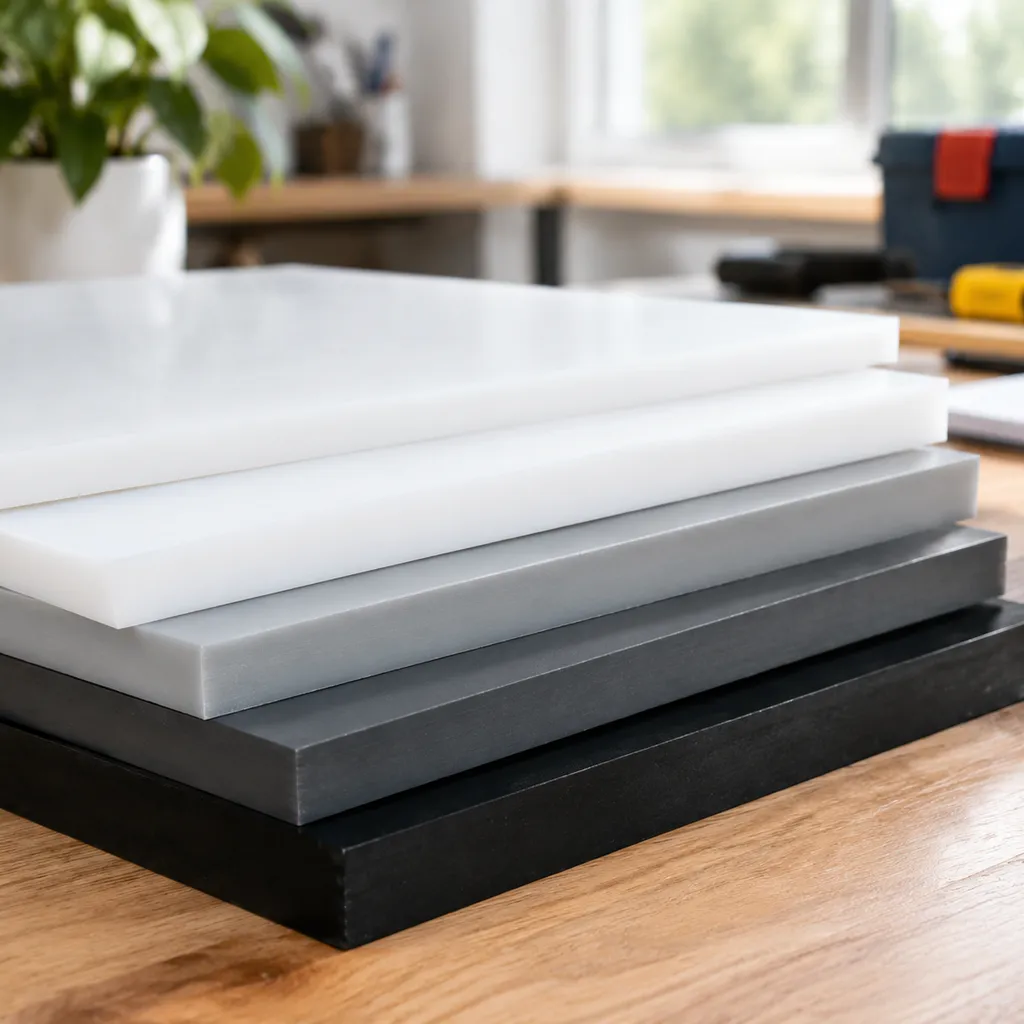
What is UHMWPE and Why is Sheet Thickness Important?
Ultra-High Molecular Weight Polyethylene (UHMWPE / PE-UHMW) is a premium engineering thermoplastic engineered for severe wear, high impact, and low-friction industrial environments. Selecting the correct UHMWPE sheet thickness is a critical engineering decision. Sheet gauge directly dictates structural rigidity, impact absorption, continuous wear life, and the structural integrity of fastener counterbores.
Choosing the right thickness prevents premature component failure, avoids unnecessary material costs, and minimizes unplanned maintenance downtime across heavy-duty industrial systems.
Understanding UHMWPE Material Properties
UHMWPE stands out from standard commodity polymers due to its exceptionally long molecular chains, typically ranging between 3.0 and 9.2+ million g/mol. This microscopic structure translates to unmatched macroscopic toughness and chemical stability.
| Technical Parameter | Standard Specification | Engineering Benefit |
|---|---|---|
| Molecular Weight | 3.0 – 9.2+ million g/mol | High tensile yield and impact resistance |
| Coefficient of Friction | 0.07 – 0.12 (Dynamic) | Self-lubricating; prevents bulk material caking |
| Water Absorption | < 0.01% | Zero dimensional swelling in wet/marine environments |
| Operating Temperature | -200°C to +80°C | Resists cryogenic cracking and moderate process heat |
| Abrasion Resistance | Superior to carbon steel | Outlasts traditional steel liners in sliding abrasion |
The Role of Thickness in Durability and Performance
Sheet thickness determines how effectively the material distributes localized stress, resists gouging, and handles mechanical fastening:
- Impact Energy Absorption: Heavier gauges provide the necessary mass to deform elastically under heavy kinetic drop loads (such as aggregate or ore impact) without cracking or puncturing.
- Sacrificial Wear Life: In high-velocity sliding abrasion applications (such as chutes and conveyor beds), thickness serves as the sacrificial service margin. Doubling the usable thickness significantly extends replacement intervals.
- Fastening Integrity: Thicker sheets allow for deeper, robust counterboring. This ensures weld studs, elevator bolts, or mechanical fasteners remain recessed below the wear surface throughout the component’s operational lifespan.
- Deflection Control: In unsupported or semi-supported installations, adequate thickness prevents panel bowing and warping caused by continuous mechanical loads or thermal expansion cycles.
Standard vs. Custom Thickness Specifications
Industrial UHMWPE sheets are primarily manufactured through high-pressure compression molding or continuous extrusion/skiving processes, offering diverse dimensional options.
- Standard Thickness Range: Off-the-shelf compression-molded sheets commonly range from 6 mm to 200+ mm, produced in standard panel sizes such as 2000×1000 mm, 3000×1500 mm, 3050×1220 mm, and 4000×2000 mm.
- Custom Gauges: For specialized OEM designs, sheets can be custom skived down to ultra-thin profiles (1 mm – 5 mm) for flexible chute backing, or cast into oversized, heavy-duty blocks exceeding 200 mm for marine fender structures and CNC-machined components.
- Precision Tolerancing: Standard industrial sheets follow tight thickness tolerances according to international standards (ISO/DIN). Custom double-side planed or CNC-milled sheets are available when precise thickness consistency is required for critical assemblies.
Standard UHMWPE Sheet Thickness Ranges
Selecting the right gauge depends entirely on your mechanical load, abrasion severity, and mounting method. In our manufacturing facility, we produce ultra high molecular weight polyethylene sheets ranging from ultra-thin skived rolls to massive compression-molded slabs up to 200 mm or more. Standard sheet formats include 2000×1000 mm, 3000×1500 mm, 3050×1220 mm, and 4000×2000 mm.
| Thickness Range | Manufacturing Method | Primary Mechanical Focus | Common Applications |
|---|---|---|---|
| 1 mm – 6 mm | Skived / Extruded | Flexibility & anti-stick sliding | Curved chute liners, wear tape, gasket backings |
| 8 mm – 25 mm | Compression Molded | Abrasion wear life & rigid fastening | Chute and hopper liners, guide rails, wear beds |
| 30 mm – 100 mm+ | Heavy Compression Molded | High-load distribution & impact absorption | Marine fender pads, outrigger pads, heavy sliders |
Refer to our complete UHMWPE sheet buying guide for full engineering tolerances and raw material certifications across these dimensions.
Thin UHMWPE Sheets (1 mm – 6 mm) for Flexible Lining
Thin-gauge sheets are designed for applications requiring high flexibility, low friction, and basic surface protection against material hang-up:
- Formability: Easily bends around radiused surfaces, conical hoppers, and curved chute profiles without pre-heating.
- Low Coefficient of Friction: Delivers a self-lubricating surface (0.07–0.12) to eliminate bulk material bridging and caking.
- Installation: Best secured using adhesive backing, weld washers, or mechanical clamping bars where fastener head depth is limited.
- Typical Uses: Dust skirts, sliding plates, packaging line wear strips, and low-impact discharge funnels.
Medium Thickness UHMWPE Sheets (8 mm – 25 mm) for General Industrial Use
Medium gauges represent the industry standard for bulk material handling and plant maintenance. These sheets provide the structural body required for secure mechanical fastening and extended wear resistance:
- Fastener Security: Provides sufficient depth for countersunk elevator bolts and weld studs, keeping bolt heads protected beneath the active wear line.
- Impact Absorption: Handles continuous aggregate flow, coal handling, and grain transfer without gouging or cracking.
- Versatility: Machinable into custom profiles, bevels, and drop-in liner sections for standard plant retrofits.
- Typical Uses: Bunker liners, conveyor wear strips, chain guides, truck bed liners, and transfer point wear plates.
Heavy-Duty Thick UHMWPE Sheets (30 mm – 100 mm+) for Structural Support
Heavy-duty slabs and blocks are engineered for severe mechanical impact, extreme compressive loads, and structural machinery components:
- Massive Load Distribution: Spreads multi-ton point loads across wide contact zones to prevent soil displacement and structural deformation.
- Zero Fracture Risk: Retains extreme notch impact strength even at cryogenic temperatures down to -200°C.
- Deep CNC Machining: Allows deep routing, heavy milling, and complex pocket machining without compromising panel rigidity.
- Typical Uses: Mobile crane outrigger pads, harbor marine fender face panels, heavy equipment ground mats, and heavy-duty sliding blocks. Explore our heavy-duty UHMWPE sheet production capabilities for custom-sawn blocks and fabricated panels.
Key Factors for Choosing the Right UHMWPE Sheet Thickness
Selecting the correct gauge ensures your installation balances impact performance, service life, and project budget. We evaluate several mechanical and operational parameters to determine the exact sheet profile for your equipment.
Load Capacity and Impact Resistance Requirements
Heavy impact demands sufficient bulk material to absorb kinetic energy without cracking or puncturing the liner:
- Drop Height and Particle Mass: Bulk materials dropped from heights above 2 meters or carrying large lump sizes require a thickness of 20 mm to 50 mm or more to prevent localized punching failure.
- Continuous Heavy Loads: For dynamic compression and heavy machinery pads, thicker profiles distribute loads evenly across the subframe.
- Kinetic Energy Absorption: Thanks to the high energy-absorption profile of ultra-high molecular weight polyethylene, properly matched thicknesses absorb continuous shock loading without brittle fracture.
Material Wear, Abrasion, and Friction Levels
Abrasive bulk handling systems require a sacrificial wear margin. While our UHMWPE grades feature an ultra-low friction coefficient (0.07–0.12) and molecular weights up to 9.2+ million g/mol, abrasive friction gradually wears down contact surfaces.
| Wear & Abrasion Severity | Typical Material Handled | Recommended Sheet Thickness |
|---|---|---|
| Light Sliding Wear | Fine powders, grain, clean packages | 6 mm – 10 mm |
| Medium Abrasion | Sand, gravel, wet coal, woodchips | 12 mm – 20 mm |
| Heavy Impact & Severe Wear | Crushed ore, heavy rock, large aggregate | 25 mm – 50 mm+ |
Operating Temperature and Thermal Expansion Margins
UHMWPE operates stably across a broad temperature range of -200°C to +80°C. However, engineering plastics expand and contract significantly more than steel:
- Thermal Deflection: Thinner sheets (under 10 mm) flex and buckle more readily if restricted during temperature swings.
- Expansion Allowances: Thicker sheets maintain structural flatness across spans but generate higher thermal expansion forces at anchoring points.
- Fastener Clearance: Slotted holes and edge gaps must be calculated based on the maximum temperature range to prevent sheet distortion.
Fastening Methods, Backing Support, and Installation
The installation design directly dictates minimum thickness specifications:
- Countersunk Bolt Depth: Fasteners must sit flush or below the sliding plane. The sheet must be thick enough to allow counter-boring while retaining sufficient base thickness under the bolt head to prevent pull-through.
- Weld Washer Inserts: When using steel weld washers, we recommend a minimum thickness of 12 mm to 15 mm to seat the metal insert securely.
- Span Between Supports: Thinner gauges require closer fastener centers (every 200 mm to 250 mm) or a continuous steel backing frame to avoid sagging under material weight. Thicker slabs (30 mm+) can bridge wider unsupported structural spans.
Recommended UHMWPE Thickness by Application
Selecting the correct UHMWPE sheet thickness comes down to balancing impact force, abrasion rates, and mounting depth. Below is our factory reference guide for sizing ultra high molecular weight polyethylene across standard industrial operations.
| Application Category | Recommended Thickness Range | Primary Selection Factor |
|---|---|---|
| Chutes, Hoppers & Silos | 10 mm – 25 mm | Abrasive wear life & fastener countersink depth |
| Conveyor Wear Strips & Guides | 5 mm – 15 mm | Continuous sliding friction & machine clearances |
| Marine Fender Face Pads | 40 mm – 120 mm | Vessel impact energy, shear stress & UV exposure |
| Crane Outrigger & Ground Pads | 30 mm – 100 mm+ | Compressive load distribution & flexural rigidity |
Chute, Hopper, and Silo Liners
Bulk material handling requires balanced impact absorption and continuous sliding flow:
- Light to Medium Sliding Abrasion (10 mm – 12 mm): Ideal for fine grains, sand, coal fines, and cement where zero hang-up is the goal.
- Heavy Impact & Large Aggregate (15 mm – 25 mm): Required when drop heights exceed 1.5 meters or when handling sharp lump ore, rock, or scrap metal.
- Mounting Consideration: Thicker sheets allow our team to machine deeper countersunk holes, ensuring weld studs and elevator bolts sit flush below the wear surface throughout the liner’s service life.
Conveyor Guide Rails, Wear Strips, and Chain Guides
For packaging lines, bottling plants, and bulk belt systems, UHMWPE minimizes friction and drive motor strain:
- Standard Profiles & Wear Strips (5 mm – 10 mm): Used under high-speed conveyor belts and modular plastic chains to prevent steel-on-steel friction.
- Heavy-Duty Chain Beds & Curved Guides (12 mm – 20 mm): Provide extra sacrificial wear volume for high-load industrial drag chains and case conveyors.
- Performance Benefit: Self-lubricating properties (friction coefficient 0.07–0.12) eliminate the need for external oils while drastically cutting line noise.
Marine Fender Pads and Dock Bumpers
Port docks and offshore terminals require extreme shear resistance and weather protection:
- Heavy-Gauge Slabs (40 mm – 120 mm): Installed directly onto steel fender frames to absorb berthing shocks from commercial vessels and barges.
- Harsh Environment Resilience: With zero water absorption (<0.01%) and high UV-stabilized molecular weight, these thick facing pads will not rot, crack, or damage ship hulls. For low-impact, lightweight dock skirting, compare these setups with our custom marine grade options to match dock specifications.
Crane Outrigger Pads and Heavy Equipment Mats
Mobile cranes, boom trucks, and drilling rigs rely on rigid, thick UHMWPE slabs to safely disperse point loads onto soft soil:
- Mid-Sized Utility Equipment (30 mm – 50 mm): Suitable for bucket trucks and light mobile cranes on asphalt or packed gravel.
- Heavy Tonnage Cranes & Civil Equipment (60 mm – 100 mm+): Compression-molded solid slabs that handle up to 100+ tons of ground pressure without bending, splintering, or failing like traditional wood blocks.
UHMWPE Thickness Considerations Across Different Material Grades
Material grade directly influences mechanical performance, wear rates, and load-bearing capacities. When choosing specialized engineering plastic materials, matching the correct sheet thickness to the specific grade ensures long service life without unnecessary material costs.
Virgin vs. Reprocessed UHMWPE Sheets
- Virgin UHMWPE: Manufactured with 100% pure polymer resins ranging from 3.0 to 9.2+ million g/mol molecular weight. Virgin sheets deliver maximum impact strength, low friction (0.07–0.12), and complete crack resistance. Because virgin material absorbs heavy impacts efficiently, standard design thicknesses (e.g., 10 mm to 20 mm) remain structurally reliable in high-load aggregate chutes.
- Reprocessed / Regenerated UHMWPE: Formulated by blending virgin resin with reclaimed industrial material. While cost-effective for standard sliding plates, reprocessed sheets have lower tensile and impact strength. To compensate for reduced impact absorption, we typically recommend increasing the sheet thickness by 15% to 30% compared to virgin grades in heavy impact zones.
| Material Grade | Impact Strength | Wear Resistance | Relative Thickness Recommendation |
|---|---|---|---|
| Virgin UHMWPE (3.0–9.2M g/mol) | Maximum (Non-breaking) | High | Baseline Standard (1.0x) |
| Reprocessed UHMWPE | Moderate | Moderate to High | +20% to +30% thicker than virgin |
| Ceramic / Glass-Enhanced | Moderate to High | Extreme | -15% to -25% thinner than virgin |
| Anti-Static / Flame-Retardant | Moderate to High | High | Standard or +10% for fastener depth |
Glass-Filled and Ceramic-Enhanced UHMWPE
Adding ceramic beads or glass particles significantly increases surface hardness and compressive strength:
- Stiffness and Creep Resistance: Filled grades show higher dimensional stability under continuous mechanical load, minimizing deformation over time.
- Thickness Optimization: Because ceramic-filled grades provide extreme abrasion resistance against abrasive sands and fine slurries, you can often downsize the sheet thickness by 2 mm to 5 mm without sacrificing overall component lifespan.
Anti-Static and Flame-Retardant Grades
- Anti-Static (ESD) UHMWPE: Formulated with carbon additives to discharge static electricity in combustible dust applications such as grain silos, coal chutes, and electronics handling. The additive load slightly reduces shear strength, requiring a minimum sheet thickness of at least 10 mm to 12 mm to ensure countersunk bolts do not pull through during heavy flow.
- Flame-Retardant UHMWPE: Designed for underground mining, rail transit, and industrial facilities requiring self-extinguishing safety compliance. Flame-retardant additives alter flexural stiffness; therefore, proper thickness calculations must account for fastener spacing and thermal expansion margins within the -200°C to +80°C operating window.
Machining and Fabrication Guidelines for Thick UHMWPE Sheets
Machining heavy-duty UHMWPE sheet thickness profiles—ranging from 20 mm up to 200+ mm compression-molded slabs—requires specific tooling setups. Because ultra-high molecular weight polyethylene has a low thermal conductivity and a low melting point relative to metals, improper cutting parameters can lead to surface melting, tool chatter, or dimensional warping. Proper tooling geometry and feed control ensure clean edges, tight tolerances, and maximum structural integrity.
Cutting and CNC Machining Best Practices
When processing thick UHMWPE plates on multi-axis CNC routers, mills, or panel saws, managing chip evacuation and heat generation is critical:
- Tooling Geometry: Use sharp high-speed steel (HSS) or polished carbide tooling. Single- or double-flute upcut spiral end mills with high rake angles (15° to 30°) deliver clean cuts without material buildup.
- Feed and Speed Optimization: Run high feed rates paired with moderate spindle speeds. High feed rates allow cutting edges to slice clean chips rather than rubbing against the material, which prevents friction heat from softening the surface.
- Chip Management: Continuous ribbon chips are typical when machining high molecular weight grades. Use high-volume vacuum extraction or continuous compressed air blasts to clear chips instantly and keep the tool path cool.
- Workholding: Secure thick slabs evenly across vacuum beds or mechanical clamps to eliminate vibration, especially when facing large-format sliding plates or outrigger pads.
For complex fabricated geometries or pre-drilled liner assemblies, submit your project specs to request a direct factory quote for precision CNC-routed parts.
Drilling, Counter-Boring, and Fastener Attachment
Fastening thick UHMWPE wear liners to steel hoppers, chutes, or equipment frames requires precise mechanical accommodations:
- Drill Bit Profiles: Standard twist drills can pull into the material too aggressively. Use modified drill bits with ground rakes and wide, polished flutes to expel material efficiently without clogging.
- Counter-Boring Depth: To protect fastener heads from abrasive bulk material or sliding impact, counter-bore holes deep enough so bolt heads sit 3 mm to 6 mm beneath the sheet surface. Maintain enough bottom wall thickness to prevent the fastener from pulling through under load.
- Thermal Expansion Slots: UHMWPE operates between -200°C and +80°C and experiences higher thermal expansion than steel substrates. When drilling fastener holes across long sheets, machine oversized or slotted holes to allow natural linear expansion and contraction without sheet buckling.
Bending and Thermal Forming Limits
Fabricators must account for the unique molecular behavior of UHMWPE when attempting form changes:
- No Molten Flow: Due to molecular weights ranging from 3.0 to 9.2+ million g/mol, UHMWPE does not melt into a liquid state; it transitions into an elastomeric gel. It cannot be thermoformed or injection molded using standard plastic processing methods.
- Cold Bending Limitations: Thin gauges can be cold-formed along generous bend radii, but heavy-duty sheets exceeding 15 mm will resist sharp cold bends and exhibit strong spring-back.
- Pre-Formed Solutions: For curved chutes, hopper transitions, or wrap-around wear profiles, thick sheets should be factory compression-molded to the required radius or CNC-machined with beveled joints rather than forced into shape on-site.
Comparing UHMWPE Thickness with Other Engineering Plastics
When replacing other polymers or sizing a new installation, thickness does not translate on a 1:1 basis. Because ultra-high molecular weight polyethylene features exceptional impact strength and abrasion resistance, you can frequently down-gauge thickness compared to lower-grade polymers, reducing overall assembly weight and material costs.
| Material | Relative Abrasion Resistance | Moisture Absorption | Thickness Substitution Ratio vs. UHMWPE |
|---|---|---|---|
| UHMWPE | Excellent (Baseline 1.0) | < 0.01% | 1.0x (Baseline) |
| HDPE | Moderate (3x–5x higher wear) | < 0.01% | 1.5x – 2.0x thicker required |
| Nylon (PA6/66) | Good (Poor in wet environments) | 6.0% – 9.0% | 1.2x – 1.5x thicker required |
| Acetal (POM) | Good (Rigid, lower impact) | 0.2% – 0.8% | 1.0x – 1.3x thicker required |
| PTFE (Teflon) | Low (Subject to cold flow/creep) | < 0.01% | 1.5x – 3.0x thicker required |
UHMWPE vs. HDPE Sheet Thickness Equivalents
While high-density polyethylene shares a similar chemical backbone, its lower molecular weight makes it significantly softer under heavy friction and impact.
- Wear and Abrasion Zones: A 10 mm to 12 mm UHMWPE sheet routinely outperforms and outlasts a 20 mm HDPE sheet in sliding plates, chute liners, and high-velocity bulk material handling.
- Structural Rigidity: HDPE has higher surface stiffness at room temperature. If your application requires structural rigidity without sliding abrasion, HDPE allows standard sheet thickness sizing at a lower material cost. For aggressive wear environments, transitioning to UHMWPE from our broader selection of engineering plastic materials delivers a far longer operating life at reduced gauges.
UHMWPE vs. Nylon and Acetal (POM)
Nylon (Polyamide) and Acetal (POM) are preferred for high mechanical stiffness and tight dimensional tolerances under static loads, but they behave very differently in high-abrasion and wet settings:
- Moisture and Swelling: Nylon absorbs ambient moisture and expands, often causing binding or warping in wet installations. UHMWPE absorbs zero moisture (<0.01%), maintaining identical dimensional thickness whether submerged or dry.
- Gauging for Sliding Friction: Under aggressive slurry or dry abrasive transport, an 8 mm UHMWPE liner consistently outwears a 12 mm to 15 mm Nylon block.
- Load-Bearing Guidelines: For high-load, rigid structural parts that cannot deflect, POM or Nylon can bear higher localized clamping forces. When replacing these with UHMWPE, we use precision plastic parts processing to fabricate thicker, ribbed, or chamfered profiles that compensate for UHMWPE’s lower flexural modulus while boosting impact durability.
UHMWPE vs. PTFE (Teflon)
PTFE excels in extreme temperature thresholds (up to +260°C) and hostile chemical environments, but it has low mechanical wear resistance and deforms easily under continuous pressure (cold flow).
- Mechanical Wear: Within standard temperature ranges (-200°C to +80°C), a 6 mm to 10 mm UHMWPE sheet delivers up to 10 times the wear resistance of a 15 mm PTFE sheet.
- Friction and Cost: Both polymers share a self-lubricating, non-stick surface with low friction coefficients (0.07–0.12). Replacing thick PTFE sliding plates with standard thickness UHMWPE delivers superior toughness, zero creep under rated loads, and substantial savings on replacement cycles.
Frequently Asked Questions About UHMWPE Sheet Thickness
What is the most commonly used UHMWPE sheet thickness?
The most common thickness range across general industrial applications is 10 mm to 25 mm (approx. 3/8″ to 1″). This medium gauge is widely deployed for chute and hopper liners, wear plates, and industrial sliding surfaces due to its balanced impact absorption and manageable weight.
- 3 mm – 6 mm: Preferred for flexible wear strips, guide rails, and light conveyor chutes.
- 10 mm – 25 mm: The global benchmark for material handling liners, aggregate chutes, and bunker protection.
- 40 mm – 100 mm+: Engineered for crane outrigger pads, heavy-duty mobile equipment mats, and marine fender face pads.
How do I determine the minimum thickness for wear liners?
To calculate the proper minimum thickness for ultra high molecular weight polyethylene liners, evaluate three core installation variables:
- Material Drop Height & Particle Size: High-impact zones with large aggregate or ore lumps require at least 20 mm to 30 mm thickness to absorb kinetic energy and prevent puncture.
- Bolt Countersink Depth: Fasteners require sufficient head clearance. If a countersunk bolt head is 6 mm deep, you need a minimum sheet thickness of 12 mm to 15 mm to retain structural integrity beneath the bolt head.
- Sacrificial Wear Rate: Estimate the abrasive wear rate over your scheduled maintenance cycle. Ensure enough sacrificial gauge remains before fasteners become exposed. When retrofitting irregular equipment, ordering precision OEM plastic parts cut to exact dimensions prevents localized edge wear.
Can multiple thin UHMWPE sheets be stacked instead of using a thick sheet?
Stacking thin sheets instead of using a single solid sheet is not recommended for heavy wear or structural loads.
- Interlayer Slippage: Because UHMWPE is inherently self-lubricating with a low coefficient of friction (0.07–0.12), stacked sheets slide against each other under load, compromising mechanical stability.
- Contamination Risk: Bulk materials, moisture, and fines can migrate between unbonded layers, causing sheets to bow, lift, or pull away from mounting bolts.
- Fastener Stress: Stacked sheets increase flexural shear forces on fasteners, leading to bolt fatigue. Always select a single solid compression-molded slab sized to your specific load demands.
Does UHMWPE thickness affect chemical and moisture resistance?
Sheet thickness does not alter the fundamental chemical or water resistance of UHMWPE. The polymer maintains virtually zero water absorption (<0.01%) and total chemical inertness across all gauges from 6 mm to 200+ mm.
However, increased thickness provides a greater physical barrier against aggressive abrasive slurry erosion and structural stress cracking in demanding operating environments ranging from -200°C to +80°C.
Pingback: Metal and Non Metallic Roofing Sheets for Durable Roofs - UHMWPE Sheet Manufacturer & Custom Plastic Machining -Jincheng