
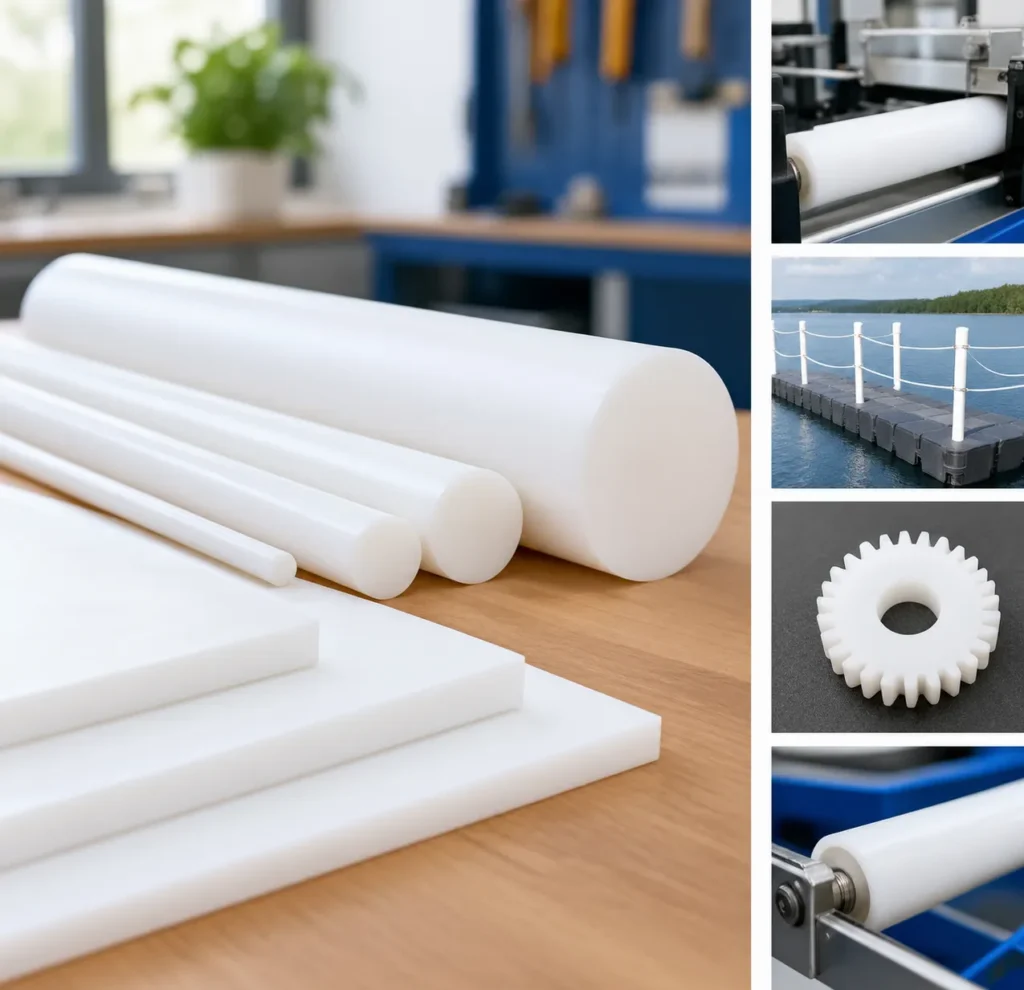
What is a UHMWPE Rod?
Understanding Ultra-High Molecular Weight Polyethylene
A UHMWPE rod is a premium semi-finished engineering thermoplastic bar produced from ultra-high molecular weight polyethylene. Unlike standard industrial polyethylenes, UHMWPE features extremely long molecular chains—typically ranging between 3.5 to 7.5 million g/mol. This dense molecular structure binds the polymer chains together tightly, transferring mechanical loads across the polymer backbone to deliver exceptional toughness, sliding efficiency, and durability under continuous mechanical stress.
Key Characteristics of UHMWPE Rod Stock
UHMWPE rod stock is engineered for demanding industrial environments where mechanical wear, friction, and harsh chemicals rapidly degrade standard materials:
- Superior Wear and Abrasion Resistance: Outlasts standard polyethylenes and carbon steel in severe abrasive slurry and sliding contact conditions.
- Low Coefficient of Friction: Delivers a slick, self-lubricating surface that prevents material buildup, galling, and component wear.
- High Impact Strength: Retains outstanding energy absorption and fracture toughness, maintaining structural integrity even at cryogenic temperatures.
- Near-Zero Moisture Absorption: Hydrophobic structure resists water absorption, preventing swelling and maintaining strict dimensional stability in wet environments.
- Chemical and Corrosion Resistance: Highly inert against harsh industrial acids, alkalis, and organic solvents.
Standard Forms, Diameters, and Sizes
UHMWPE rods are manufactured through ram extrusion or compression molding to ensure uniform density and stress-relieved machinability.
| Specification | Standard Range | Features & Options |
|---|---|---|
| Diameter Range | 10 mm to 300 mm (0.5″ to 12″+) | Solid round bar profile |
| Standard Lengths | 1000 mm, 2000 mm, 3000 mm | Custom cut-to-length stock available |
| Standard Colors | Natural (White/Translucent), Black, Green | Custom color-matching available |
| Surface Finish | Smooth, extruded / planed | Ready for precision CNC turning and milling |
Key Physical and Mechanical Properties of UHMWPE Rods
When choosing engineering plastics for demanding mechanical components, UHMWPE stands out due to its unique molecular structure. The exceptionally long molecular chains give each rod superior durability compared to standard polyolefins. We manufacture and supply round rods engineered to excel under extreme mechanical and environmental stress. Discover why ultra high molecular weight polyethylene stands out across heavy industry through the specific physical and mechanical characteristics detailed below.
Superior Wear and Abrasion Resistance
UHMWPE rod stock delivers unmatched wear resistance in harsh sliding and scraping environments:
- Outlasts Metals: Significantly outperforms carbon steel, bronze, and stainless steel in abrasive slurry and dry contact conditions.
- Minimal Surface Degradation: Resists gouging, scratching, and material loss over long operating cycles.
- Mating Part Protection: Soft enough to prevent galling or premature wear on mating metal surfaces while maintaining structural integrity.
Low Coefficient of Friction and Self-Lubrication
Our UHMWPE rods provide a dry, slick surface that eliminates the need for external lubricants:
- Non-Stick Surface: Prevents bulk materials, wet powders, and residues from adhering to components.
- Smooth Motion: Delivers a low coefficient of friction (comparable to PTFE), reducing drive torque and energy consumption in conveyor and roller setups.
- Maintenance-Free Operation: Ideal for clean environments where grease and oil contamination must be avoided.
High Impact Strength and Toughness
The molecular density of UHMWPE provides unmatched impact resistance even in harsh conditions:
- High Energy Absorption: Absorbs severe shock loads, vibrations, and repeated impacts without cracking, chipping, or fracturing.
- Cryogenic Toughness: Retains flexibility and impact strength at sub-zero temperatures down to -150°C and below.
- Ductile Performance: Yields under extreme point loads rather than failing catastrophically.
Chemical, Moisture, and Corrosion Resistance
UHMWPE rod material is chemically inert and completely resistant to water degradation:
- Zero Moisture Absorption: Minimal water absorption ensures complete dimensional stability in submerged, high-humidity, or washdown conditions.
- Broad Chemical Resistance: Resists aggressive acids, alkalis, corrosive salts, and organic solvents.
- Zero Corrosion: Will not rot, rust, or degrade when exposed to salt water, harsh cleaning agents, or outdoor weathering.
Common Grades and Variations of UHMWPE Rods
We produce and supply ultra high molecular weight polyethylene rod stock in several formulation grades. Choosing the right variation ensures the optimal balance between cost, mechanical strength, and regulatory compliance.
Virgin vs. Reprocessed UHMWPE
- Virgin Grade UHMWPE: Manufactured from 100% pure, unblended polymer resin. It delivers peak performance with the highest impact strength, superior wear resistance, and uncompromised chemical resistance. Typically supplied in natural white, virgin rod stock is the industry baseline for critical sliding parts and tight-tolerance machining.
- Reprocessed (Regrind) Grade: Formulated by blending virgin polymer with clean, reclaimed production scrap. While it slightly reduces tensile strength and impact resistance compared to virgin material, it retains a low coefficient of friction and dependable abrasion resistance at a lower price point. Common in black or green, reprocessed rods serve non-sanitary mechanical guides and scrapers. For broader material evaluation criteria across solid formats, explore our UHMWPE sheet buying guide to assess grade tradeoffs.
FDA-Compliant Food Grade UHMWPE
Our food-grade UHMWPE rods comply with FDA and USDA standards for direct contact with raw foodstuffs, beverages, and pharmaceuticals.
- Non-Toxic & Hygienic: Zero odor, non-leaching, and physiologically inert.
- Zero Moisture Absorption: Will not harbor bacteria, swell from water exposure, or degrade under harsh chemical clean-in-place (CIP) washdowns.
- Color Coding: Readily available in standard white as well as high-visibility blue for optical contamination detection on automated packaging and processing lines.
Specialty Modified Grades (Anti-Static, Glass-Filled, UV-Resistant)
To handle demanding environments where standard polyethylene reaches its operational limits, we provide specialized modified grades:
- Anti-Static (ESD) Grade: Infused with conductive carbon additives to dissipate static electricity build-up, preventing sparks and material adhesion in hazardous dust or electronic assembly lines.
- UV-Stabilized Grade: Enhanced with chemical light stabilizers and carbon black to resist ultraviolet radiation, eliminating brittleness and surface breakdown in outdoor marine and mining environments.
- Glass-Filled Grade: Reinforced with micro-glass fibers to increase rigidity, raise structural tensile strength, and minimize thermal expansion under heavy mechanical loads.
- Oil-Filled / Enhanced Self-Lubrication: Pre-lubricated formulations designed to lower surface friction and prevent dry running in unlubricated conveyor bushings and high-speed wear tracks.
Major Industrial Applications of UHMWPE Rods
Because of their superior wear resistance, low coefficient of friction, and high impact strength, UHMWPE rods serve as a workhorse material across heavy industries. We turn and mill this solid rod stock into durable parts that outlast traditional metals and standard plastics under harsh working conditions.
Material Handling and Conveyor Components
Modern automated lines rely heavily on components machined from round stock to keep products moving smoothly and quietly. We frequently machine these rods into custom wear components, guide rollers, and specialized conveyor parts that protect moving goods from scuffs.
- Reduced Line Drag: The self-lubricating surface lowers friction, reducing drive motor strain.
- Noise Dampening: Absorbs mechanical vibrations to create significantly quieter plant environments.
- Abrasive Resistance: Prevents premature failure in lines transporting sand, grain, cardboard, or glass.
Bushings, Bearings, Rollers, and Gears
Machined UHMWPE rod bushings and sleeve bearings provide exceptional reliability in environments where external lubricants like grease or oil cannot be used due to contamination risks or extreme debris.
- Dry-Running Capability: Eliminates the need for ongoing grease maintenance.
- Zero Galling: Operates against mating steel shafts without scratching or seizing.
- Shock Absorption: Absorbs severe impact loads without cracking or deforming permanently.
Marine and Harbor Infrastructure
Marine environments quickly degrade metals and wood, but UHMWPE remains unaffected by prolonged submersion. We fabricate heavy-duty dock components, fender facings, and wear shoes directly from large-diameter rods.
- Zero Water Absorption: Will not swell, rot, or lose mechanical strength when submerged in saltwater.
- Mooring Protection: Low-friction surfaces let vessel hulls slide smoothly along docks without catching.
- Weather Resistance: Maintains high impact toughness in freezing harbor waters.
Food Processing, Packaging, and Medical Devices
In food packaging and processing plants, cleanliness and chemical resilience are critical. Non-porous UHMWPE rod is one of the most reliable engineering plastic materials for sanitary sorting, filling, and handling systems.
- FDA and USDA Compliance: Safe for direct food contact without leaching chemicals or odors.
- Washdown Resilience: Resists aggressive chemical cleaning agents, steam, and high-pressure sanitizing washes.
- Zero Bacterial Growth: Non-stick, smooth surfaces prevent material buildup and simplify daily sanitation routines.
Machining and Processing Guidelines for UHMWPE Rods
Machining ultra-high molecular weight polyethylene (UHMWPE) rods requires a specific approach compared to conventional metals or rigid polymers. Because UHMWPE is soft, ductile, and prone to heat buildup, using proper tooling setups and chip management ensures clean cuts, precise dimensions, and smooth surface finishes.
CNC Turning, Drilling, and Milling Techniques
When cutting and shaping UHMWPE rod stock, keep these standard machining practices in mind:
- CNC Turning: Use positive rake angles and ground, razor-sharp cutting edges. UHMWPE produces continuous, stringy shavings that can wrap around the chuck or spindle, so set up chip breakers or air blasts to clear swarf quickly.
- CNC Milling: High-speed two-flute or single-flute end mills offer the chip clearance needed to prevent material buildup. This process is ideal for creating customized wear tracks, bushings, or guide components used in automated packaging assemblies and custom can turning device systems.
- Drilling: Use polished twist drills with wide flutes. Employ a continuous peck-drilling cycle to evacuate chips and dissipate friction heat. Backing out frequently prevents the drill bit from binding in the rod.
Tooling, Speeds, and Feeds Recommendations
To maintain high wear resistance and prevent surface melting during machining, prioritize sharp tools and aggressive chip removal rather than friction-inducing light passes.
| Parameter | Recommended Specification |
|---|---|
| Tool Material | High-Speed Steel (HSS) or polished, uncoated micro-grain carbide |
| Cutting Speed | 250 – 450 m/min (800 – 1,500 ft/min) for turning and milling |
| Feed Rate | 0.25 – 0.50 mm/rev (0.010 – 0.020 in/rev) |
| Rake Angle | 15° to 30° positive rake angle |
| Clearance Angle | 10° to 15° relief angle |
| Cooling Method | High-volume compressed air or water-soluble flood coolant |
Managing Thermal Expansion and Tolerances
UHMWPE has a significantly higher coefficient of thermal expansion than metals and rigid engineering plastics. As heat builds during machining, the plastic expands and may shrink below nominal dimensions after cooling.
- Allow for Heat Dissipation: Always measure finished components only after they have cooled completely to room temperature (approx. 20°C to 23°C / 68°F to 73°F).
- Roughing and Finishing Passes: For high-precision parts, perform heavy roughing passes first, let the stock normalize, and then make a light finish cut to hit the final target dimensions.
- Design for Practical Tolerances: Because of the natural elasticity and thermal movement of UHMWPE, specify functional working tolerances (typically ±0.1 mm to ±0.2 mm / ±0.005″ to ±0.008″) rather than overly tight metallic tolerances.
UHMWPE vs. Other Engineering Plastics
Selecting the right polymer stock for your components comes down to balancing impact resistance, friction, load capacity, and environment. While UHMWPE rod stock stands out for aggressive wear environments, understanding how it stacks up against other standard engineering thermoplastics ensures you pick the exact material for your operation.
| Property | UHMWPE | HDPE | POM (Acetal / Delrin) | Nylon (PA6/PA66) | PTFE (Teflon) |
|---|---|---|---|---|---|
| Wear & Abrasion Resistance | Best-in-class | Moderate | High | High | Low to Moderate |
| Impact Strength | Extremely High | Moderate to High | Moderate | High | Moderate |
| Coefficient of Friction | Extremely Low | Low | Low | Low to Moderate | Lowest |
| Moisture Absorption | < 0.01% (Near Zero) | < 0.01% | 0.20% – 0.25% | 1.5% – 3.0% (High) | < 0.01% |
| Machinability (Tolerances) | Flexible / Moderate | Easy | Excellent (Tight) | Good | Soft / Creeps |
UHMWPE vs. HDPE
While both materials originate from the polyethylene family, their molecular chain length creates distinct performance tiers:
- Abrasion and Impact: UHMWPE features molecular chains up to 10 times longer than standard polyethylene. This gives it vastly superior wear resistance and impact toughness under continuous friction.
- Cost and Machining: Standard materials covered in our comprehensive HDPE plastic guide offer easier thermoforming, standard welding capabilities, and a lower raw material cost for basic liquid tanks, light piping, and structural boards.
- Best Choice: Choose UHMWPE rod stock when components face heavy abrasive slurry, continuous mechanical wear, or punishing kinetic impacts.
UHMWPE vs. POM (Delrin/Acetal)
Polyoxymethylene (POM) and UHMWPE often compete in sliding component design:
- Dimensional Stability and Rigidity: POM is stiffer, holds tighter machining tolerances, and provides higher mechanical yield strength. It is the go-to choice for precision micro-gears and rigid structural fixturing.
- Friction and Chemical Resistance: UHMWPE delivers superior self-lubrication, better dry-sliding behavior against metal mating surfaces, and higher resistance to harsh acids and caustic washdowns.
- Best Choice: Use POM for high-load, tight-tolerance mechanical parts; choose UHMWPE where impact dampening, chemical inertness, and non-stick sliding are critical.
UHMWPE vs. PTFE (Teflon) and Nylon
PTFE and Nylon are widely specified industrial plastics, but they serve different operational envelopes:
- UHMWPE vs. PTFE: PTFE excels in extreme continuous temperatures (up to 260°C / 500°F) and carries the lowest friction coefficient available. However, PTFE is soft, prone to mechanical creep (cold flow), and wears out quickly under heavy mechanical loading. UHMWPE delivers significantly higher tensile strength and gouge resistance at standard industrial temperatures.
- UHMWPE vs. Nylon: While parts like a heavy-duty industrial nylon slider offer high mechanical stiffness and excellent static load capabilities, Nylon readily absorbs ambient moisture. This moisture uptake causes dimensional swelling and changes in mechanical properties. In contrast, UHMWPE absorbs zero water, making it far superior for washdown zones, marine hardware, and wet processing lines.
Selection and Buying Guide for UHMWPE Rods
Selecting the right UHMWPE rod requires matching the material grade directly to your mechanical demands, chemical exposures, and manufacturing tolerances. We help procurement teams and engineers select rod stock that maximizes component service life while eliminating unnecessary material costs.
Assessing Operating Environment and Load Requirements
Before purchasing rod stock, evaluate the continuous working conditions of your equipment. While ultra high molecular weight polyethylene offers industry-leading impact strength and a self-lubricating surface, environmental limits dictate its long-term reliability.
| Operating Condition | Key Performance Factor | Material Recommendation |
|---|---|---|
| Continuous Abrasive Wear | Abrasion resistance and low coefficient of friction | High molecular weight virgin rod stock |
| Chemical / Washdown Exposure | Chemical resistance and low moisture absorption | Unfilled virgin UHMWPE |
| Outdoor / Direct Sunlight | UV degradation prevention | UV-stabilized modified grade |
| Dust-Prone Conveyor Systems | Static dissipation | Anti-static / conductive UHMWPE |
Choosing the Right Grade and Regulatory Compliance
Choosing the correct polymer formulation ensures compliance with global engineering and health standards:
- Virgin UHMWPE: Delivers maximum wear resistance, pure white or natural finish, and high tensile strength for heavy-duty mechanical parts.
- FDA-Compliant Grade: Essential for direct food contact, packaging lines, and pharmaceutical processing. It resists sanitation chemicals and will not harbor bacterial growth due to zero moisture absorption.
- Reprocessed / Eco Grades: A cost-effective solution for non-sanitary wear pads, standard guide rails, and general material handling where certified virgin resin is not mandatory.
- Specialty Additives: Glass-filled, ceramic-filled, or oil-filled variations designed for elevated structural rigidity or ultra-low friction applications.
Evaluating Machining and Sizing Specifications
UHMWPE rod stock is typically extruded or compression-molded slightly oversize to accommodate precision CNC turning, boring, and milling. When sizing your stock, account for the unique thermal dynamics of semi-crystalline plastics:
- Diameter and Length Allowances: Order rod stock with sufficient exterior machining stock to clean up outer skin stresses and hit exact nominal diameters.
- Thermal Expansion Management: UHMWPE expands and contracts significantly more than metals. Maintain tight coolant flow during fabrication to prevent heat build-up and part distortion.
- Tooling Selection: Use sharp, polished carbide tooling with high positive rake angles. If you are prepping custom billets alongside flat wear profiles, review our guide to cutting methods for clean edge quality and stress-free blanks.
Frequently Asked Questions About UHMWPE Rods
What makes UHMWPE rods better than standard polyethylene?
UHMWPE (ultra high molecular weight polyethylene) rods feature significantly longer molecular chains than standard polyethylene grades like HDPE or LDPE. This distinct molecular structure delivers notable performance advantages:
- Superior Wear Resistance: Outlasts carbon steel and standard plastics in abrasive sliding environments.
- High Impact Strength: Resists cracking, chipping, or fracturing even under heavy shock loads and freezing temperatures.
- Self-Lubricating Surface: Provides a remarkably low coefficient of friction that prevents product sticking and reduces mechanical drag.
If you need custom stock diameters to solve tough abrasion challenges, feel free to request a quote based on your target specifications.
Can UHMWPE rods be easily machined with standard tools?
Yes. UHMWPE rod stock can be turned, drilled, milled, and cut using conventional metalworking and woodworking equipment. To achieve clean finishes and precise tolerances, we recommend following these standard machining practices:
- Use Sharp Tooling: High-speed steel (HSS) or carbide cutters with generous rake angles produce clean cuts and reduce surface burrs.
- Maintain High Feed Rates: Continuous cutting prevents heat buildup and eliminates melting or gumming along the tool edge.
- Ensure Adequate Support: Because the material is flexible, support long rod lengths properly in lathe chucks and steady rests to prevent deflection.
Are UHMWPE rods suitable for direct food and medical contact?
Virgin UHMWPE rods are fully non-toxic, odorless, and chemically inert, making them an FDA compliant choice for direct contact with food, beverages, and pharmaceuticals. Their zero-to-low moisture absorption ensures they will not harbor bacteria, swell in washdown cycles, or degrade when exposed to harsh cleaning chemicals. If you are developing sanitary processing equipment or specialty parts, get in touch via our contact page for tailored grade recommendations and sizing assistance.