
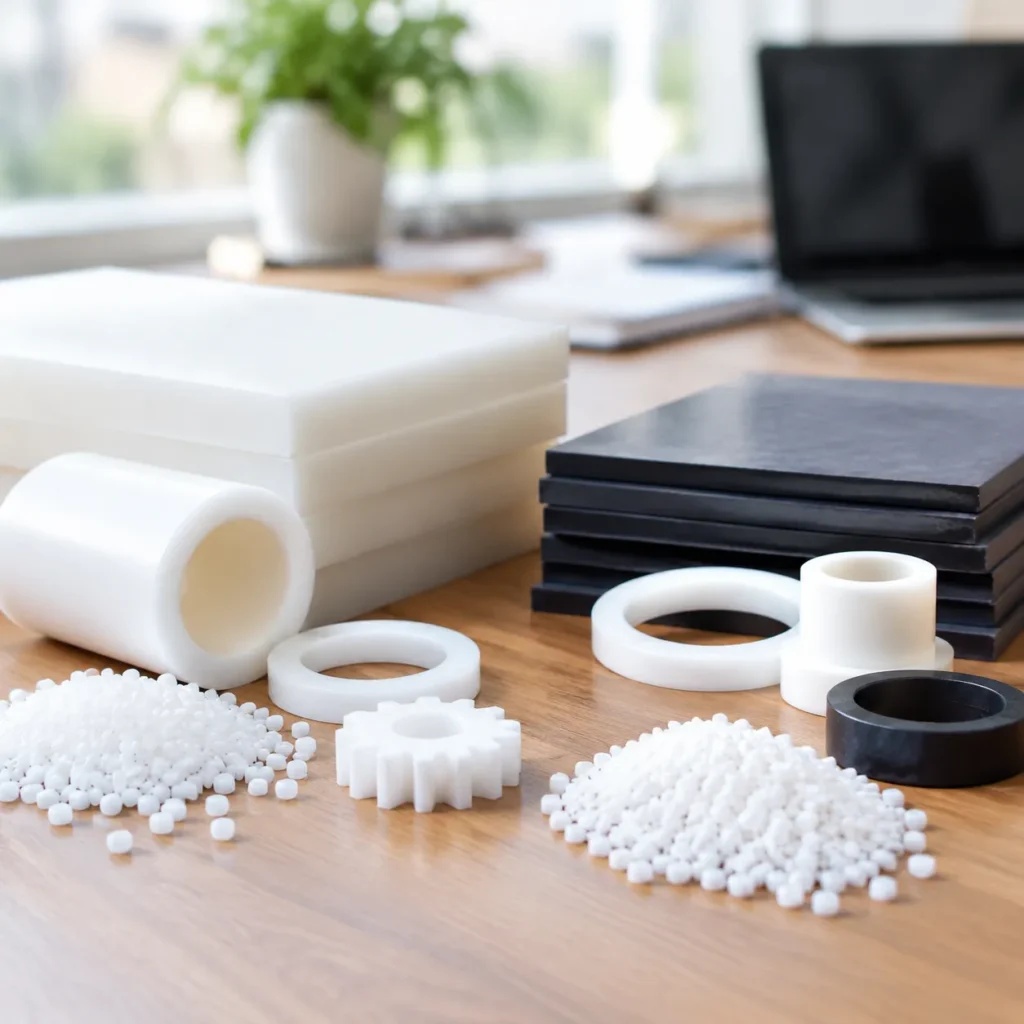
Are you struggling to choose between two of industry’s most popular low-friction plastics?
At first glance, they seem interchangeable. Both are ultra-slick, chemical-resistant, and engineered for high-demand environments.
Pick the wrong one, though, and you face premature part failure, melted seals, or blown budgets. One can shrug off brutal abrasive wear and extreme impact, while the other dominates in searing temperatures and aggressive chemical baths.
To help you make the right call, here is UHMWPE vs PTFE: Key Differences Explained—covering thermal thresholds, mechanical wear, machinability, and real-world costs.
If you want clear, practical guidance to spec the perfect polymer the first time, this guide is for you.
Let’s dive right in.
Overview of UHMWPE and PTFE
Selecting the right high-performance polymer directly impacts equipment longevity, maintenance cycles, and operational efficiency. Two engineering plastics lead the modern industrial market: UHMWPE and PTFE. While both deliver exceptional low-friction performance, their underlying molecular architectures create vastly different mechanical, thermal, and chemical behaviors.
What is UHMWPE (Ultra-High Molecular Weight Polyethylene)?
Ultra-High Molecular Weight Polyethylene (UHMWPE) is a specialized engineering thermoplastic categorized by its extremely long polyethylene chains. With molecular weights typically ranging between 3.5 and 7.5 million g/mol—compared to standard industrial polyethylene at 0.05 to 0.3 million g/mol—this material is built for extreme mechanical abuse.
- Supreme Toughness: High molecular entanglement transfers and absorbs mechanical stress efficiently.
- Exceptional Wear Resistance: Outperforms carbon steel and most engineered polymers in high-abrasion sliding scenarios.
- Low Surface Friction: Inherently self-lubricating, preventing bulk material sticking and sliding wear.
- High Impact Strength: Does not shatter or crack, even in cryogenic operating conditions down to -150°C (-238°F).
What is PTFE (Polytetrafluoroethylene)?
Polytetrafluoroethylene (PTFE)—commonly recognized by the brand name Teflon—is a synthetic fluoropolymer of tetrafluoroethylene. Its structure consists entirely of carbon and fluorine atoms, forming one of the strongest single bonds in organic chemistry: the carbon-fluorine (C-F) bond.
- Universal Chemical Resistance: Chemically inert to virtually all industrial acids, alkalis, and solvents.
- Extreme Temperature Stability: Operates continuously from cryogenic levels up to +260°C (+500°F).
- Ultra-Low Coefficient of Friction: Possesses one of the lowest friction coefficients of any solid material.
- Dielectric Superiority: Outstanding electrical insulation properties across diverse frequencies and environmental conditions.
Core Characteristics and Molecular Differences
The performance boundary between UHMWPE and PTFE is dictated entirely by their molecular architecture. UHMWPE relies on mechanical chain entanglement for toughness, while PTFE relies on bond strength for chemical and thermal stability.
| Property / Feature | UHMWPE | PTFE |
|---|---|---|
| Polymer Class | Ultra-high molecular weight polyolefin | High-density fluoropolymer |
| Chemical Formula | $(C_2H_4)_n$ | $(C_2F_4)_n$ |
| Molecular Structure | Long, linear, highly entangled hydrogen-carbon chains | Helical carbon chain sheathed by electronegative fluorine atoms |
| Density | \approx 0.93 – 0.94 g/cm³ (Floats in water) | \approx 2.15 – 2.20 g/cm³ (Dense and heavy) |
| Primary Strength | Abrasion resistance & mechanical impact | Thermal resistance & chemical inertness |
| Primary Limitation | Low continuous operating temperature limit (\approx 80 °C / 176 °F) | Low wear resistance and susceptible to cold flow (creep) |
UHMWPE vs PTFE: Key Property Differences
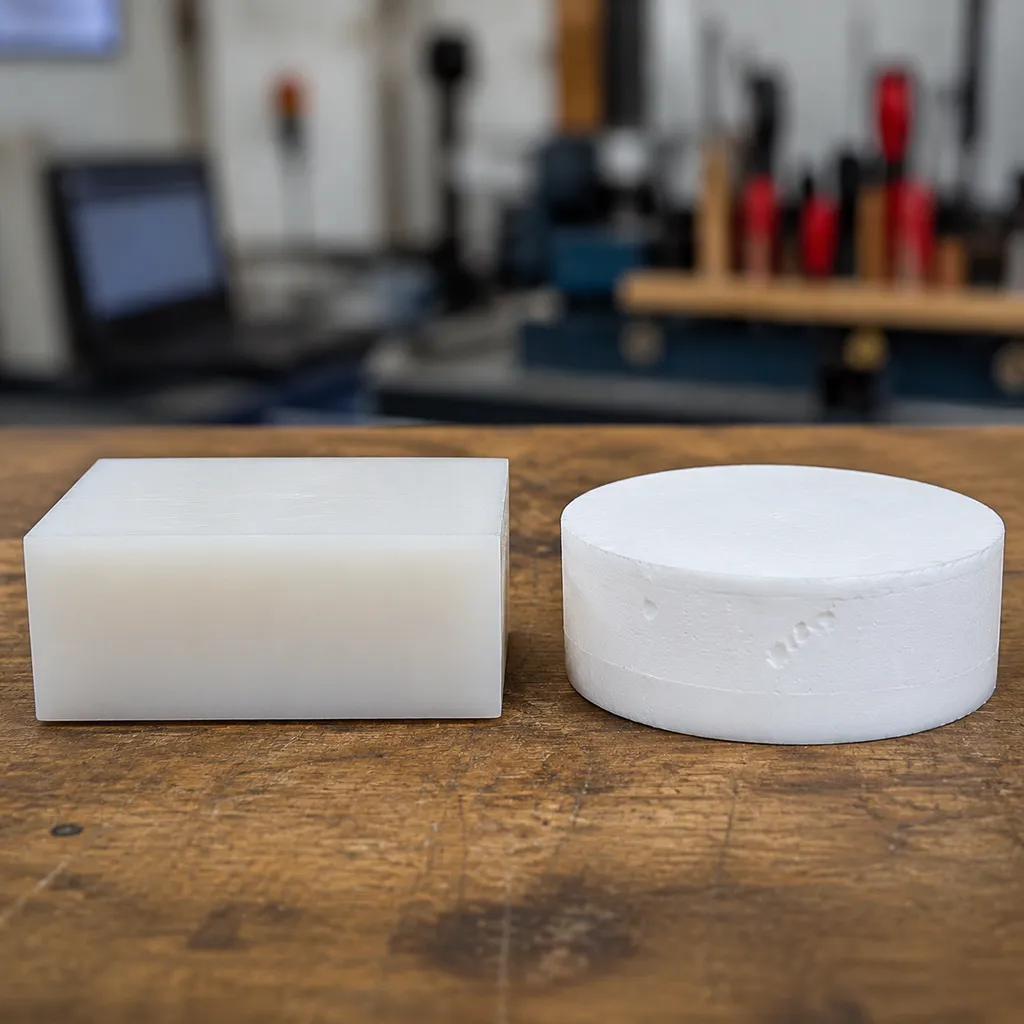
When we
compare ultra-high molecular weight polyethylene (UHMWPE) and polytetrafluoroethylene (PTFE), the decision usually
comes down to three operational factors: operating heat, abrasive friction, and chemical severity. Both materials deliver self-lubricating performance
, but their mechanical profiles solve completely different engineering problems.
| Property | UHMWPE | PTFE (Teflon) |
|
:— | :— | :— |
| Continuous Service Temp | -200°C to
80°C (-328°F to 176°F) | -200°C to
260°C (-328°F to 500°F) |
|
Coefficient of Friction (Dynamic) | 0.10 – 0.15 | 0.04 – 0.1
0 |
| Abrasion & Wear Resistance | Outstanding (Industry benchmark) | Moderate (Prone to creep and mechanical
wear) |
| Impact Strength | Extremely high (Does not break) | Moderate |
| Chemical Resistance
| Excellent (Acids, alkalis, brine) | Universal (Practically inert to all media) |
Temperature Resistance and Thermal Performance
PTFE is the clear winner for extreme thermal loads. It maintains mechanical integrity and non-stick performance
at continuous operating temperatures up to 260°C (500°F), and handles intermittent exposure up to 3
00°C.
UHMWPE cannot compete at high temperatures. It softens near 80°C to
90°C (176°F to 194°F) and melts around 135
°C. However, in sub-zero and cryogenic environments down to -200°C, UHMWPE outperforms
PTFE by retaining high impact ductility without becoming brittle.
Coefficient of Friction and Slipperiness
PTFE boasts one of the lowest
coefficients of friction of any solid material, typically between 0.04 and 0.10. It feels
nearly frictionless to the touch, which prevents stick-slip behavior in low-speed slide mechanisms.
UHMWPE is
exceptionally slick as well, with a dynamic coefficient of friction around 0.10 to 0.15.
While PTFE is technically slippery, we find that UHMWPE provides a more stable sliding surface under heavy mechanical loads because it resists
cold flow and deformation much better than pure PTFE.
Abrasion Resistance and Impact Strength
This is where UHMWPE dominates
. Its long molecular chains yield extraordinary wear resistance—outlasting PTFE, carbon steel, and polyurethane in high-wear slurry
and sliding environments. To maintain long service life in bulk handling, identifying and managing UHMWPE sheet wear issues ensures
your equipment runs without downtime.
- Impact Energy Absorption: UHMWPE absorbs massive shock loads without fracturing, cracking
, or chipping. - Resistance to Creep: PTFE suffers from cold flow (deformation under static pressure). UH
MWPE resists continuous mechanical gouging and heavy point loads significantly better. - Surface Toughness: While PTFE scratches
and erodes easily under gritty conditions, UHMWPE deflects abrasive particles smoothly.
Chemical Inertness and Corrosion
Resistance
PTFE is virtually inert across the entire pH scale (0–14). It resists aggressive boiling acids, organic
solvents, and strong oxidizing agents, reacting only with molten alkali metals and elemental fluorine at high pressures.
UHMWPE offers
superb corrosion resistance against water absorption, salt solutions, caustic alkalis, and most industrial acids. However, strong oxidizing acids
(like concentrated nitric acid) and certain aromatic or halogenated hydrocarbons will degrade UHMWPE over extended exposure. If your
system runs aggressive solvents at high heat, PTFE is mandatory; for general corrosive slurries and washdown environments, UHMWPE delivers
superior structural stability.
Manufacturing, Processing, and Cost Comparison
Neither UHMWPE nor PTFE can be processed like conventional thermoplastics. Because of their exceptionally high molecular weight and zero melt flow, standard injection molding and blow molding are off the table. Converting both materials into usable shapes demands specialized heavy-machinery techniques.
Processing Techniques: Sintering and Ram Extrusion
Both materials start as fine polymer powders. To turn these powders into solid stock shapes, we rely on two primary methods:
- Compression Molding and Sintering: We press the loose resin into a mold under immense hydraulic pressure to form a green compact. Next, we sinter it in high-heat ovens. UHMWPE fuses at roughly 200°C (392°F), whereas PTFE requires temperatures reaching 360°C to 380°C (680°F to 716°F) to coalesce, demanding significantly higher energy and dedicated fume extraction systems.
- Ram Extrusion: To produce continuous rods, profiles, and tubes, a hydraulic ram repeatedly packs incremental powder charges through a heated barrel and die. This continuous cycle fuses the particles under heat and backpressure.
| Processing Parameter | UHMWPE | PTFE |
|---|---|---|
| Melt Flow Index (MFI) | Near 0 (Extremely high melt viscosity) | Non-flowing gel state above melt point |
| Sintering Temperature | ~200°C (392°F) | ~360°C – 380°C (680°F – 716°F) |
| Primary Forming Methods | Compression molding, ram extrusion | Cold compression + sintering, paste/ram extrusion |
| Cycle Times | Moderate to long heating/cooling cycles | Long heat soaking required to prevent thermal shock |
Machinability and Fabrication Considerations
Both polymers machine cleanly on standard CNC routers, mills, and lathes, but their physical structures require distinct approaches during specialized plastic parts processing:
- PTFE Machining: PTFE is soft and yields easily under tool pressure. It generates stringy chips and creeps easily if clamped too tightly in a chuck. We use razor-sharp, polished carbide tools with positive rake angles and minimal clamping force to hold precise tolerances.
- UHMWPE Machining: UHMWPE is ductile and tough. It does not chip; instead, it shears off in long, continuous ribbons that can wrap around spindles if chip clearance is inadequate. It also has a high coefficient of thermal expansion, meaning parts will expand rapidly if frictional heat builds up. Coolants, sharp tooling, and aggressive feed rates prevent heat buildup, following standard guidelines similar to how to cut HDPE sheet safely and accurately.
Material Cost and Long-Term Value
Raw material pricing creates a massive divide between these two materials:
- Raw Material Expense: PTFE typically costs 3 to 5 times more per pound than UHMWPE. Fluoropolymer synthesis involves complex, energy-intensive chemical steps, which drives up baseline pricing.
- Fabrication Yield and Scrap: UHMWPE scrap can often be reground and reused in lower-grade utility sheet runs. PTFE scrap re-sintering is far more restrictive and often yields inferior mechanical grades.
- Long-Term ROI: For high-wear, high-impact industrial applications—such as chute liners, belt guides, and wear strips—UHMWPE delivers vastly superior cost efficiency and service life. PTFE is economically justified only when service temperatures exceed 90°C (194°F) or when direct contact with harsh, aggressive solvents makes fluoropolymer chemical inertness non-negotiable.
Industrial Applications: UHMWPE vs PTFE
When selecting between these engineering plastics, we evaluate the balance between mechanical abuse and environmental extremes. While both materials offer exceptionally low surface friction, their real-world industrial installations rarely overlap because their load bearing capacity, heat thresholds, and wear resistance profiles serve completely different operational conditions.
Common Uses for UHMWPE in Wear and Impact Components
Ultra-high molecular weight polyethylene dominates environments where mechanical abrasion, gouging, and heavy shock loads destroy standard materials. Because of its outstanding impact strength and self-lubricating surface, we rely on UHMWPE across heavy industry:
- Bulk material handling: Chute, silo, and hopper liners that resist continuous gouging from aggregate, coal, ore, and grain while preventing material hang-ups.
- Conveyor and packaging lines: Chain guides, wear strips, star wheels, and curved tracks. We regularly supply UHMWPE wear-resistant scrapers for conveyors to cleanly remove sticky bulk carryback without grooving or damaging rubber belts.
- Heavy wear plates and outrigger pads: Crane outrigger pads and sliding plates. Determining the proper profile with our UHMWPE sheet thickness guide for industrial applications ensures components withstand severe ground-bearing pressures without cracking or permanent deformation.
- Marine and harbor structures: Fender facing pads and dock bumpers that absorb the repeated, massive impact of docking vessels in abrasive saltwater conditions.
Common Uses for PTFE in High-Temp and Chemical Environments
Polytetrafluoroethylene (PTFE, commonly known as Teflon) is the premier choice where high thermal demands and aggressive chemicals cause other plastics to melt, degrade, or dissolve. We turn to PTFE for:
- Chemical processing gaskets and seals: Flange gaskets, valve seats, diaphragms, and pump packings exposed to concentrated acids, bases, and aggressive organic solvents across a wide temperature range.
- High-temperature pipe and vessel linings: Fluid handling systems carrying hot corrosive chemicals at temperatures up to 260°C (500°F).
- High-frequency electrical insulation: High-voltage cable jacketing, RF connectors, and printed circuit boards requiring superior dielectric strength and minimal signal loss.
- Cleanroom and pharmaceutical hardware: Ultra-pure chemical piping, fittings, and laboratory vessels that demand complete chemical inertness and zero trace-element leaching.
Specialized Film, Tape, and Bearing Applications
In thin-gauge and rotational friction applications, the choice between PTFE and UHMWPE comes down to service temperature versus particulate exposure:
- PTFE thread seal tapes and non-stick films: Skived PTFE films provide unmatched performance as non-stick release barriers on heat-sealing machinery, chemical-resistant barrier wraps, and thread-sealing plumber tapes.
- PTFE composite sleeve bearings: Frequently blended with bronze, carbon, or glass fillers, PTFE bearings thrive in dry, maintenance-free, moderate-load pivot points, commercial baking lines, and clean chemical valves.
- UHMWPE bushings and sleeve bearings: The clear winner in dirty, wet, or slurry-filled environments—including dredging equipment, forestry machinery, and wastewater treatment agitators—where abrasive particles would quickly embed in and wear down softer PTFE bushings.
Selection Guide: Which Material Should You Choose?
Choosing between ultra-high molecular weight polyethylene and polytetrafluoroethylene comes down to your operating environment. When we help clients engineer components, we balance mechanical abuse against thermal and chemical stress.
When to Choose UHMWPE
Pick UHMWPE if your primary enemies are physical wear, heavy impact, and aggressive abrasion. It delivers unmatched mechanical toughness at a fraction of the cost of fluoropolymers.
- Extreme Abrasive Wear: Ideal for chute liners, conveyor guides, and hopper beds handling sand, aggregate, or grain. Check our comprehensive UHMWPE sheet buying guide to size the right grade for high-wear bulk handling.
- Heavy Impact Loads: Where brittle materials crack under repeated shock loads, UHMWPE absorbs the energy without shattering.
- Budget-Conscious Projects: If your operating temperatures stay below 80°C (180°F), UHMWPE delivers superior wear resistance without the premium price tag of fluoropolymers.
- Dynamic Conveying: Essential for low-friction wear strips and guide components. Review our breakdown on selecting chain guide rail materials to see how UHMWPE stacks up against alternative plastics in continuous motion setups.
When to Choose PTFE
Specify PTFE when your system faces brutal heat, aggressive solvents, or requires the lowest possible breakaway friction.
- High Continuous Temperatures: Operates reliably up to 260°C (500°F), far exceeding the thermal ceiling of standard polyethylenes.
- Universal Chemical Resistance: PTFE handles exposure to hot acids, bases, organic solvents, and caustic chemicals without swelling or degrading.
- Zero-Stick & Ultra-Low Friction: Best for non-lubricated seals, valve seats, and slide plates where absolute slipperiness and zero stick-slip behavior are mandatory.
- Electrical Insulation: Superior dielectric properties make it the top candidate for high-frequency electrical isolators and aerospace wiring insulation.
UHMWPE vs PTFE Quick Comparison Table
| Performance Property | UHMWPE (Ultra-High Molecular Weight Polyethylene) | PTFE (Polytetrafluoroethylene / Teflon) |
|---|---|---|
| Max Continuous Temp | ~80°C (180°F) | ~260°C (500°F) |
| Abrasion Resistance | Outstanding (Highest among thermoplastics) | Moderate (Susceptible to abrasive wear) |
| Impact Strength | Extremely high (Does not break in standard tests) | Moderate |
| Coefficient of Friction | Low (~0.10 – 0.20) | Extremely low (~0.04 – 0.10) |
| Chemical Resistance | Excellent (Resists most acids, bases, and salts) | Universal (Inert to virtually all industrial chemicals) |
| Load Bearing & Creep | Good creep resistance under moderate mechanical loads | Prone to cold flow/creep under continuous load |
| Material Cost | Economical | High to premium |
| Best Suited For | Slurries, impact bumpers, wear strips, liners | High-temp seals, valve seats, corrosive fluid lines |