
Understanding HDPE and Cutting Characteristics
Mastering how to cut HDPE sheet materials starts with understanding the unique physical behavior of the polymer. High-Density Polyethylene behaves differently than wood, metal, or brittle acrylics under cutting tools. Because it is a soft, ductile thermoplastic, cutting it requires the right balance of tool speed, feed rate, and blade geometry to achieve a clean edge without gumming or melting.
What is High-Density Polyethylene (HDPE)?
High-Density Polyethylene (HDPE) is a petroleum-derived thermoplastic known for its high strength-to-density ratio, incredible impact resistance, and chemical durability. It is widely used in industrial, marine, and commercial applications because it does not rot, splinter, or absorb moisture.
- Key Properties of HDPE:
- Low Friction Coefficient: Extremely slick surface with non-stick properties.
- Zero Moisture Absorption: Ideal for marine environments and food-grade surfaces.
- High Impact Strength: Absorbs shocks and mechanical stresses without cracking.
- Low Melting Point: Begins softening around 130°C to 135°C (266°F to 275°F).
Why HDPE Can Be Challenging to Cut
While HDPE is softer than many standard plastics, its specific thermal and mechanical properties introduce unique challenges during the cutting process:
- Frictional Melting (Plastic Re-Welding): Due to its low thermal conductivity, heat generated by standard high-speed blades quickly melts the plastic. This molten material can instantly re-fuse behind the blade, clogging teeth and ruining cuts.
- Blade Grabbing and Binding: HDPE is pliable rather than brittle. Dull or incorrect blades tend to grab and pull the flexible sheet rather than slice through it cleanly.
- Thermal Expansion: As the sheet heats up during long cuts, it expands rapidly, potentially pinching the saw blade and causing kickback.
- Slick Clamping Surfaces: The low surface energy of HDPE makes it prone to slipping under clamps, leading to inaccurate feed lines if not properly secured.
| Cutting Challenge | Cause | Result on Workpiece |
|---|---|---|
| Edge Melting | High tool RPM / slow feed rate | Gummed edges, blade clogging, re-welded seams |
| Rough / Frayed Edges | High tooth count or dull teeth | Stringy burrs, jagged finish |
| Kickback / Binding | Thermal expansion / blade pinch | Tool stall, dangerous kickback, ruined cuts |
Essential Tools for Cutting HDPE Sheets
Selecting the right equipment is the most critical step in learning how to cut HDPE sheet materials cleanly without melting or gumming up your blades. High-density polyethylene behaves differently than wood or metal, meaning your tooling needs to clear chips fast while managing frictional heat.
Circular Saw and Table Saw for Straight Cuts
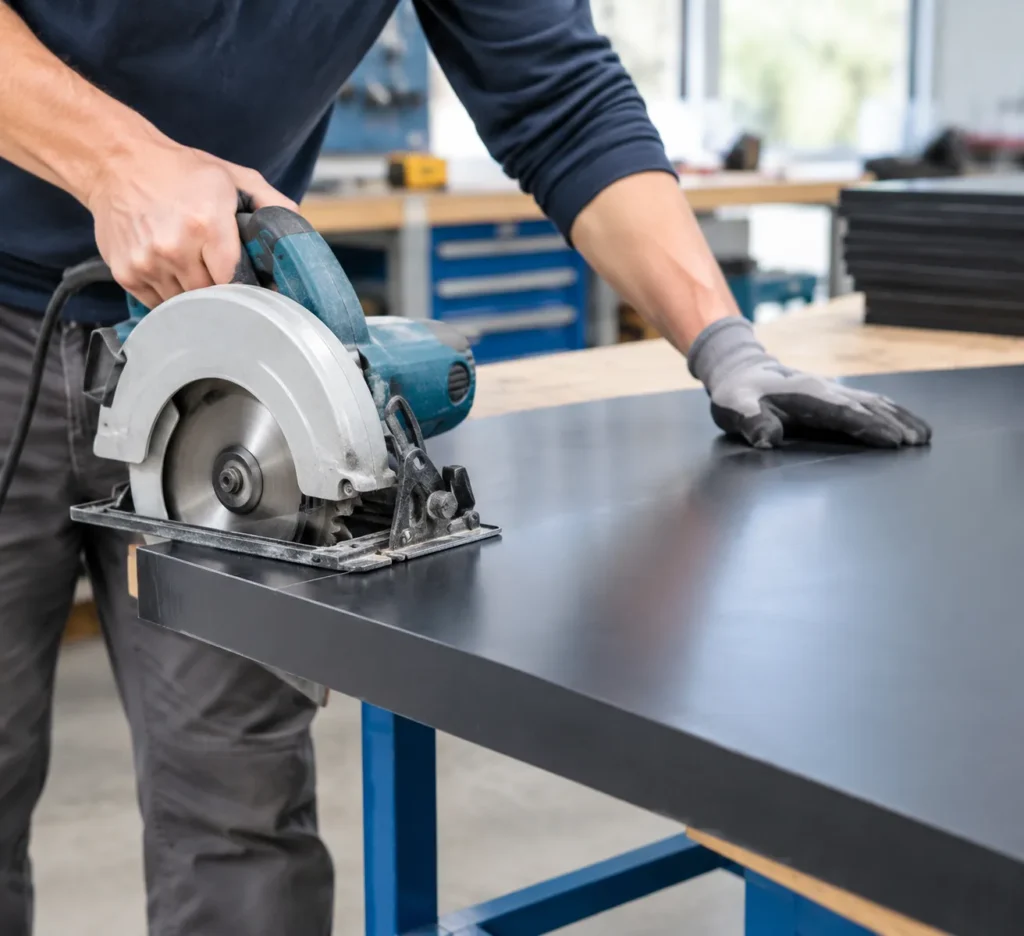
For long, straight rip cuts and crosscuts, a table saw or handheld circular saw is our go-to setup in the shop. These tools deliver clean edges on medium-to-thick panels when set up properly.
- Table Saw: Best for repeatable dimensions, ripping wide panels, and maintaining absolute 90-degree square edges.
- Circular Saw: Ideal for breaking down large 4×8-foot sheets that are too cumbersome to run across a saw table safely. Always use a rigid straight edge guide clamp to keep the line true.
- Feed Rate: Keep the sheet moving smoothly. Pausing mid-cut causes friction, which quickly melts the plastic against the blade body.
Jigsaw for Curved and Intricate Cuts
When you need to cut radiuses, irregular contours, or interior cutouts, a jig saw offers the maneuverability you need. Standard coarse wood blades tend to tear the plastic edge, so we recommend blades designed specifically for non-ferrous metals or plastics.
- Use medium-to-high tooth count blades (10–14 TPI) with zero or minimal side set.
- Turn off any orbital action settings to prevent the blade from aggressively chipping the bottom edge.
- Set the tool to a moderate stroke speed to prevent localized thermal buildup along tight corners.
CNC Router for Precision Machining
For complex profiles, bevels, pockets, and industrial tolerances, a CNC router is the premier choice. CNC machining eliminates manual feed inconsistencies and yields pristine, burr-free edges directly off the bed.
Using single-flute or double-flute spiral upcut carbide bits ensures rapid chip evacuation. For large-scale manufacturing runs or bespoke industrial projects, utilizing high-grade polyethylene plastic plate boards sheet for mass production CNC machining parts guarantees tight tolerances and minimal post-processing scrap.
Utility Knife for Thin Sheets
For thin gauge sheets up to 1/8-inch (3mm) thick, power tools are often unnecessary. A heavy-duty utility knife paired with the scoring and snapping method yields fast, razor-sharp edges without generating plastic dust.
- Clamp a metal straightedge securely along your cut mark.
- Make 3 to 5 firm scoring passes with the blade to groove approximately one-third through the material thickness.
- Align the score line over a sharp table edge and apply even, downward pressure to cleanly snap the piece along the line.
Choosing the Right Blade for Cutting HDPE
Picking the right blade is the most important step in mastering how to cut HDPE sheet material cleanly. High-density polyethylene has a low melting point and a tendency to grab cutting teeth. Using the wrong blade creates excessive friction, gumming up your tool and fusing melted plastic right behind the cut line.
Optimal Tooth Count and Blade Geometry
When cutting high-density polyethylene on a table saw or circular saw, fewer teeth often deliver better results. Standard high-tooth wood blades generate too much heat, while blades designed with deep gullets clear hot plastic chips before they can melt.
- Tooth Count: For a standard 10-inch blade, use 24 to 40 teeth. For a 7-1/4-inch circular saw, stick to 18 to 24 teeth. This spacing provides ample chip clearance.
- Tooth Grind: A Triple Chip Grind (TCG) tooth configuration is the industry standard for plastics. It alternates between a flat raker tooth and a higher trapezoid tooth, balancing cutting pressure and leaving a smooth edge.
- Rake Angle: Use a neutral or negative rake blade (0° to -5°). A negative rake prevents the blade from aggressively self-feeding or grabbing the soft HDPE sheet, ensuring consistent control through the cut—a technique similar to what we use when cutting UHMW sheets and other slippery thermoplastics.
Carbide-Tipped Blades vs. Standard Wood Blades
Standard high-speed steel (HSS) woodworking blades dull rapidly when cutting dense polymers, increasing heat and leaving jagged, melted edges. Upgrading to the proper cutting material makes an immediate difference.
| Feature | Carbide-Tipped Blades (Plastic / Non-Ferrous) | Standard Wood Blades (HSS) |
|---|---|---|
| Cut Quality | Crisp, razor-sharp edge with minimal burrs | Rough edge with melted plastic beads |
| Heat Resistance | High (dissipates friction efficiently) | Low (retains heat, causing blade gumming) |
| Blade Longevity | Retains sharpness across thousands of cuts | Dulls quickly on dense plastic sheets |
| Kickback Risk | Low (controlled chip removal) | Higher (teeth tend to dig in and bind) |
Always choose a dedicated carbide-tipped plastic cutting blade or a non-ferrous metal blade over standard wood blades. The polished carbide tips slice through high-density polyethylene cleanly without creating friction-induced melting or edge tear-out.
Step-by-Step Guide: How to Cut HDPE Sheets
Mastering how to cut HDPE sheet material requires a disciplined approach to tool setup, feed control, and material stability. High-density polyethylene reacts differently to power tools than timber or metal because friction generated during the cut can quickly lead to thermal expansion or edge melting. Following these exact steps guarantees crisp, dimensionally accurate cuts every single time.
Step 1: Measuring and Marking the Cut Line
HDPE has a non-stick, waxy surface that makes standard pencil marks practically invisible and easy to rub off.
- Apply painter’s tape: Lay down a strip of blue painter’s tape over the intended cut path. This gives you a high-contrast background and prevents ink from smudging.
- Mark your dimensions: Use a fine-point permanent marker and a straight edge to draw your cut line clearly.
- Account for kerf loss: Factor in the 2.5 mm to 3.2 mm (1/8 inch) blade kerf width when planning consecutive cuts to ensure your final pieces maintain exact tolerances.
Step 2: Supporting and Securing the Sheet
Flexing and vibration are the main causes of rough edges, blade binding, and kickback when cutting dense plastics.
- Provide full under-panel support: Place a sheet of sacrificial foam board or scrap plywood beneath the HDPE panel. This supports both sides of the cut line and prevents tear-out on the bottom edge.
- Clamp securely: Use bar clamps with rubber pads to lock the sheet firmly against your workbench. Avoid bare metal clamp jaws, as they can permanently dent the soft plastic surface.
- If you are working on large-scale industrial projects where in-shop cutting proves inefficient, sourcing factory-machined polyethylene UHMWPE and HDPE cut-to-size boards saves extensive labor and eliminates edge-finishing steps.
Step 3: Setting the Correct Speed and Feed Rate
Balancing rotational tool speed (RPM) and manual feed rate keeps cutting temperatures well below the 130°C (266°F) melting point of high-density polyethylene.
| Tool Setup Factor | Recommended Setting | Purpose |
|---|---|---|
| Blade Speed (RPM) | Moderate to Low (approx. 3,000–4,000 RPM) | Reduces friction-induced heat generation |
| Feed Rate | Moderate and Steady (approx. 3–5 meters/min) | Keeps plastic chips large rather than turning into dust |
| Blade Height | 6 mm to 10 mm (1/4″ to 3/8″) above the sheet | Maximizes chip clearance and cools the teeth |
Step 4: Executing the Cut
Once your guide rails are clamped and tool speeds configured, execute the cut with deliberate, continuous motion:
- Start the tool before contact: Let the circular saw, table saw, or jigsaw reach full operating speed before the blade touches the plastic edge.
- Maintain uninterrupted movement: Push the blade through the material at a steady, uninterrupted pace. Stopping or hesitating mid-cut creates friction heat at a single point, which immediately melts the plastic around the blade teeth.
- Clear the cut path: Ensure chips eject freely. If you notice plastic curling into hot strings rather than throwing clean flakes, increase your feed speed slightly to cool down the blade.
- Complete the pass: Push the tool entirely past the edge of the sheet and let the motor wind down fully before moving the workpiece or setting the saw down.
Techniques for Different HDPE Sheet Thicknesses
HDPE behaves differently depending on material thickness. Thin sheets respond well to manual shearing methods, while thicker stock requires high-torque power tools with specific feed rates to prevent friction melting. Choosing the right method depends directly on gauge and application, much like selecting between UHMWPE vs HDPE vs Nylon sheet materials for fabrication.
| Sheet Thickness | Recommended Tool | Best Technique | Primary Consideration |
|---|---|---|---|
| Thin (< 3 mm / 1/8″) | Heavy-duty utility knife | Scoring and snapping | Deep scores, fast snap |
| Medium (3 mm – 12 mm / 1/8″ – 1/2″) | Circular saw / Table saw | Single continuous pass | High feed rate, steady support |
| Thick (12 mm+ / 1/2″+ & Blocks) | Table saw / Band saw | Multi-pass or slow band cut | Chip clearing, heat reduction |
Cutting Thin HDPE Sheets (Score and Snap)
For thin sheets up to 1/8-inch (3 mm) thick, skip the power tools and use the scoring and snapping method. This produces clean edges with zero plastic dust:
- Secure the Guide: Clamp a rigid steel straightedge firmly along the cut line to prevent slipping.
- Score Deeply: Draw a heavy-duty utility knife along the guide. Make 4 to 6 deliberate, heavy passes until you have cut through at least one-third to one-half of the sheet’s total thickness.
- Align the Edge: Move the scored line directly over the sharp edge of your workbench. Clamp the sheet down flat on the supported side.
- Snap Cleanly: Place a flat board over the overhang for even pressure, then apply quick, forceful downward pressure to snap the sheet cleanly along the scored line.
Cutting Thick HDPE Sheets and Blocks
Stock thicker than 1/4-inch (6 mm) and solid high-density polyethylene blocks require power tools like a table saw, heavy-duty circular saw, or a band saw.
- Use Multi-Pass Cutting: When cutting stock over 1 inch (25 mm) thick on a table saw, do not force the cut in a single pass. Raise the blade to take half the thickness on the first pass, flip the stock, and complete the cut on the second pass.
- Maintain High Feed Rates: Move the material steadily through the blade. Hesitating causes the teeth to spin in one spot, rapidly generating frictional heat that melts the plastic instead of slicing it.
- Clear Chips Continuously: Thick cuts generate massive amounts of plastic shavings. Ensure your dust collection is running, or blow compressed air at the cut zone to stop molten chips from fusing back onto the cut face.
- Use Deep Throats for Contours: For thick contoured parts, use a band saw fitted with a 3 to 4 TPI skip-tooth blade. The deep gullets carry thick plastic shavings out of the kerf efficiently without binding.
How to Smooth and Finish HDPE Edges
Even with the cleanest cut, high-density polyethylene often leaves behind slight burrs, saw marks, or sharp rims. Because HDPE does not take well to flame polishing or standard plastic solvents, mechanical edge cleanup is the best way to get a professional, snag-free edge.
Deburring with a Utility Knife or Deburring Tool
Deburring is the fastest way to remove plastic fuzz and sharp corners right after cutting.
- Swivel-head deburring tool: This is my go-to tool for plastics. Pull the curved blade along the edge in a single, smooth motion. The blade swivels automatically to match the contour, peeling off a neat ribbon of excess material.
- Utility knife scraping: If you do not have a dedicated deburring tool, hold a sharp utility knife blade at a trailing 45-degree angle against the corner. Drag the blade backward along the edge rather than cutting forward. This scrapes away burrs without digging into or gouging the workpiece.
- Beveling edges: Running your scraper across both top and bottom corners creates a consistent micro-chamfer that prevents edge chipping and makes handling much safer.
Sanding and Scraping for a Smooth Finish
To remove visible saw teeth marks and create a factory-grade finish, use a combination of scraping and controlled sanding.
| Method | Recommended Tool / Grit | Best Result For |
|---|---|---|
| Edge Scraping | Card scraper or flat utility blade | Removing saw marks and leveling flat edges |
| Coarse Sanding | 120 to 180-grit wet/dry paper | Smoothing heavy ridges and tool chatter |
| Fine Sanding | 240 to 400-grit wet/dry paper | Matte, uniform satin surface finish |
When sanding HDPE, always keep friction heat to a minimum. Power sanders running at high RPMs will quickly melt the plastic, clogging your sandpaper with sticky buildup. I recommend hand sanding with a hard sanding block and using a drop of water as a lubricant to keep the cut cool and the abrasive clean.
If you are fabricating sliding components, guide rails, or protective tracks where a bare machined edge is exposed to constant friction, installing pre-profiled U-shaped and F-shaped plastic wear-resistant strips can save hours of edge-finishing labor while delivering maximum durability.
Pro Tips to Prevent Melting and Chipping
High-density polyethylene has a relatively low melting point, which means friction from a power tool can quickly turn a clean cut into a gummy, melted mess or cause brittle edges to chip. When learning how to cut HDPE sheet materials cleanly, keeping blade temperature down and feed rates consistent is essential for factory-grade results.
Controlling Heat Buildup During Cutting
Heat is the primary cause of melted edges and blade binding when machining thermoplastics. We use several core techniques to keep friction under control:
- Maintain a Steady Feed Rate: Never stop or pause the tool mid-cut. Lingering in one spot allows the blade teeth to rub against the plastic, rapidly generating friction heat that re-welds the cut seam.
- Optimize Tool Speed: Lower your saw’s RPM if variable speed is available, while maintaining a brisk feed speed to ensure the teeth cut chips rather than rub the material.
- Clear Plastic Chips Promptly: Evacuate debris immediately using a vacuum attachment or a continuous blast of compressed air directed right at the cut point.
- Select the Correct Tooth Geometry: A negative rake blade or a blade designed specifically for plastics reduces the aggressive bite and ejects hot chips before they can melt back onto the workpiece.
| Factor | Recommended Setting | Risk if Incorrect |
|---|---|---|
| Blade Type | Carbide-tipped, triple-chip grind (TCG) | Standard wood blades generate excess friction |
| Feed Pace | Brisk and continuous | Slow feed melts edges; jerky feed causes chip-out |
| Cooling | Compressed air blast or mist | Overheating leads to blade gumming and binding |
Avoiding Common HDPE Cutting Mistakes
Achieving smooth, accurate edges requires steering clear of standard woodworking habits that do not translate well to high-density polyethylene.
- Using Dull Blades: Dull cutting edges tear and stretch plastic instead of slicing it cleanly. Always use sharp carbide tooling, especially when cutting dense structural sheets or customized stock like an UHMWPE plastic chopping board.
- Inadequate Clamping: Flexible sheets vibrate easily under the force of a table saw, circular saw, or band saw. Unclamped sheets chatter against the blade, creating jagged cuts and micro-fractures along the edge.
- Using High-Tooth Fine Crosscut Blades: Blades with high tooth counts (80+ teeth) trap chips in the gullets, leading directly to friction heat. Stick to 40- to 60-tooth blades for general sheet thickness.
- Forcing the Cut: Let the tool do the work. Forcing the blade through dense stock bends the sheet and deflects the cut line, resulting in beveled edges and rough finishes.
Safety Precautions When Working with HDPE
Cutting high-density polyethylene requires the same respect you give to hardwoods or non-ferrous metals. While HDPE does not produce hazardous dust like fiberglass, power tools operating at high RPMs create flying chips, sharp drop-offs, and friction heat that demand standard workshop precautions.
Recommended Personal Protective Equipment (PPE)
Always gear up before powering on any saw or router:
- Safety Glasses or Face Shield: High-speed cutting ejects dense plastic shavings that can cause eye injuries. A full-face shield is ideal when operating a table saw or router.
- Hearing Protection: High-tooth saw blades spinning through thick polymer sheets generate high-frequency noise. Use earplugs or earmuffs rated for workshop environments.
- Respiratory Protection: While HDPE is non-toxic, dry sanding or high-speed machining can generate airborne micro-particles. An N95 dust mask keeps your airways clear.
- Fitted Hand Protection: Use cut-resistant gloves when handling freshly cut edges or trimming with a utility knife. Never wear loose gloves near spinning blades, as they can catch and pull your hand into the tool.
Workplace Ventilation and Plastic Chip Management
Machining high-density polyethylene produces ribbon-like shavings and static-charged plastic chips that scatter across the workspace. Managing these waste particles is crucial for safety and cut quality:
- Slip Hazard Control: HDPE chips act like tiny roller bearings on smooth concrete shop floors. Sweep or vacuum cutting zones regularly to prevent slips and falls.
- Active Chip Extraction: Hook your saws up to a dedicated dust collector or shop vacuum. Clear extraction prevents shavings from packing into the cut channel, which reduces friction and blade binding.
- Thermal Ventilation: When blades run too hot, HDPE can melt and release mild localized odors. Ensure your workspace has steady airflow to disperse any heat buildup.
Whether cutting standard panels in your shop or handling high-volume plastic parts processing, maintaining clean workstations and adhering to these safety protocols ensures consistent cuts and a safe working environment across all engineering plastic materials.
Pingback: UHMWPE vs PTFE Key Differences Uses and Selection Guide - UHMWPE Sheet Manufacturer & Custom Plastic Machining -Jincheng