
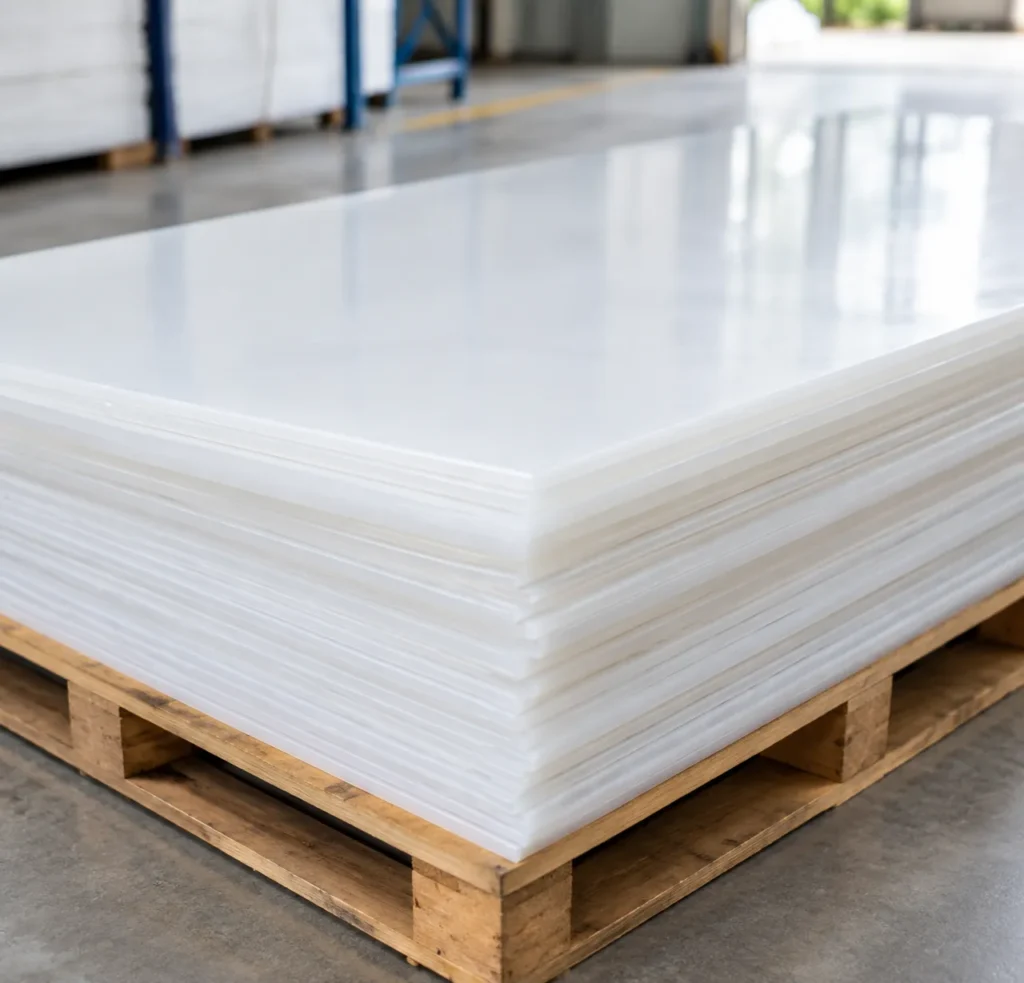
Finding a versatile material that delivers extreme impact strength, zero moisture absorption, and total chemical resistance can be tough.
That is why the HDPE high density polyethylene plastic sheet has become the undisputed workhorse across marine, food processing, and heavy industrial applications.
In this complete guide, you’ll discover everything you need to know—from standard sheet sizes and specialized grades to CNC fabrication tips and direct material comparisons.
Let’s dive right in.
What is HDPE (High-Density Polyethylene) Plastic Sheet?
An HDPE (high-density polyethylene) plastic sheet is a high-performance, semi-crystalline thermoplastic panel renowned for its exceptional durability, impact resistance, and versatile processing capabilities. Engineered through the low-pressure polymerization of ethylene, these commercial-grade sheets deliver an outstanding strength-to-density ratio, making them a cost-effective, reliable replacement for wood, metal, and lower-grade plastics across global industrial, marine, and food processing markets.
Definition and Material Composition
HDPE is a petroleum-derived polyolefin characterized by a tightly packed, linear molecular structure with minimal branching. This unique molecular architecture gives high-density polyethylene distinct mechanical advantages over low-density alternatives.
- Base Polymer: Polymerized ethylene molecules creating high-density, linear crystalline chains.
- Density Range: Typically spans from 0.941 to 0.965 g/cm³, delivering enhanced rigidity and tensile strength.
- Material Variants: Available in virgin HDPE resins for high-purity and food-grade compliance, as well as high-grade reprocessed/recycled formulations for secondary industrial applications.
- Surface Chemistry: Non-polar, non-porous, and self-lubricating, preventing chemical adhesion, moisture retention, and bacterial growth.
Physical and Mechanical Properties
The balance of rigidity, ductility, and environmental stability makes the HDPE plastic sheet an essential choice for harsh working environments.
| Property | Typical Value (Imperial) | Typical Value (Metric) | Testing Standard |
|---|---|---|---|
| Density | 0.0344–0.0348 lb/in³ | 0.95–0.96 g/cm³ | ASTM D792 |
| Tensile Strength at Yield | 3,800–4,600 psi | 26.2–31.7 MPa | ASTM D638 |
| Flexural Modulus | 150,000–200,000 psi | 1,034–1,379 MPa | ASTM D790 |
| Izod Impact Strength (Notched) | 1.5–3.0 ft-lb/in | 80–160 J/m | ASTM D256 |
| Hardness (Shore D) | 65–70 | 65–70 | ASTM D2240 |
| Water Absorption (24 hrs) | < 0.01% | < 0.01% | ASTM D570 |
| Continuous Service Temp. | -58°F to 180°F | -50°C to 82°C | Continuous |
Core Performance Highlights:
High Impact Strength: Absorbs significant kinetic energy without shattering or cracking, even in sub-zero environments.
Moisture Resistance: Zero moisture uptake eliminates rotting, swelling, splintering, and delamination.
Chemical Resistant Matrix: Resists aggressive acids, alkalis, alcohols, and organic solvents.
Low Coefficient of Friction: Minimizes wear on mating components and enables smooth material flow in bulk handling.
Standard Sheet Sizes, Thicknesses, and Tolerances
HDPE sheets are produced to international standards to accommodate heavy fabrication, machining, and structural installations. We supply full production runs as well as precision cut to size panels configured to exact project blueprints.
Standard Dimensions
- Imperial Sizes: 48″ x 96″ (4×8 ft), 48″ x 120″ (4×10 ft), 60″ x 120″ (5×10 ft)
- Metric Sizes: 1000 mm x 2000 mm, 1220 mm x 2440 mm, 1500 mm x 3000 mm
Gauge and Thickness Availability
- Thin Gauge Sheets: 1/16″ (1.5 mm), 1/8″ (3 mm), 3/16″ (4.7 mm)
- Standard Plate: 1/4″ (6.35 mm), 3/8″ (9.5 mm), 1/2″ (12.7 mm), 3/4″ (19 mm), 1″ (25.4 mm)
- Heavy Structural Slab: 1-1/4″ (31.7 mm) up to 4″ (100 mm+)
Manufacturing Tolerances
- Thickness Tolerances: ± 5% to ± 10% depending on gauge and extrusion/compression molding methods.
- Length & Width Tolerances: Standard mill trim of -0.00″ / +0.250″ (± 6.35 mm), with precision CNC tolerances achievable down to ± 0.005″ (± 0.127 mm).
Key Features and Advantages of HDPE Sheets
We engineer every hdpe high density polyethylene plastic sheet to deliver dependable performance in demanding industrial, commercial, and marine environments. Below are the key characteristics that make our sheets a top-tier material choice worldwide.
| Core Feature | Performance Advantage | Typical Benefit |
|---|---|---|
| High Tensile & Impact Strength | Resists cracking, chipping, and heavy physical shock | Long service life under mechanical stress |
| Zero Moisture Absorption | Water and fluid barrier (<0.01% absorption rate) | Will not rot, swell, peel, or harbor bacteria |
| Broad Chemical Resistance | Inert to harsh acids, alkalis, and solvents | Reliable containment and corrosion protection |
| FDA / USDA Compliance | Non-toxic, non-porous, and odor-free | Direct food contact safety and simple sanitation |
| UV & Weather Resistance | Formulated with UV inhibitors for outdoor exposure | No chalking, degradation, or brittleness in direct sun |
High Impact Strength and Durability
Our HDPE sheets offer exceptional impact resistance across wide operating temperature ranges. The rigid molecular structure absorbs heavy drops, vibrations, and mechanical stress without fracturing or splintering. While heavy-duty industrial systems occasionally require specialized materials like ultra-high molecular weight polyethylene engineering plastics for extreme abrasion zones, our commercial-grade HDPE provides the optimal balance of stiffness, high impact strength, and structural resilience for standard fabrication.
- Shatterproof Performance: Handles heavy physical loads without snapping.
- Low Friction Surface: Prevents surface scuffing and reduces wear during material transfer.
- Stress Crack Resistance: Withstands continuous dynamic loads without fatigue.
Chemical, Moisture, and Corrosion Resistance
HDPE is completely non-polar and hydrophobic, meaning it absorbs virtually zero moisture. This makes it an ideal, chemical-resistant barrier for industrial chemical handling, wastewater containment, and wet processing lines.
- Total Moisture Resistance: Won’t swell, delaminate, or warp in high-humidity or submerged applications.
- Corrosion-Free: Replaces traditional steel and wood components that degrade over time.
- Broad Chemical Compatibility: Resists most acids, alcohols, cleaning agents, and organic solvents.
FDA Compliance and Food Safety
Manufactured from high-purity virgin HDPE resins, our sanitary food-grade sheets comply with strict FDA, USDA, and NSF standards for direct food handling.
- Non-Porous Surface: Prevents juice, blood, and moisture penetration to stop bacterial growth.
- Knife-Friendly Density: Used globally for commercial cutting boards because it preserves knife edges without gouging easily.
- Easy Sanitization: Handles hot-water washdowns, industrial detergents, and steam cleaning without degrading.
UV Stability and Weather Resistance
For outdoor and marine installations, our marine-grade HDPE sheets feature dedicated UV inhibitors and thermal stabilizers.
- All-Weather Endurance: Performs consistently from sub-zero winter temperatures up to continuous heat without becoming brittle.
- Color Retention: Resists yellowing, fading, and surface chalking from continuous sunlight exposure.
- Marine-Tough: Impervious to salt spray, algae, mold, and harsh marine washdowns.
Common Types and Grades of HDPE Plastic Sheets
Selecting the right grade of HDPE high density polyethylene plastic sheet depends entirely on your working environment, exposure levels, and mechanical requirements. We supply and fabricate several specialized grades designed to maximize lifespan and performance across diverse industries.
Natural and Black General-Purpose Sheets
Natural (milky white) and black general-purpose sheets are the standard workhorses of industrial plastic fabrication.
- Natural Virgin HDPE: Formulated without pigments, offering excellent chemical resistance, low friction, and high purity. Widely used in chemical storage tanks, chute linings, and machined components.
- Black Utility & UV Grade: Infused with carbon black additives to provide superior resistance to sunlight and UV degradation. It is the go-to choice for outdoor agricultural panels, piping flanges, and heavy-duty liners.
- Machining Performance: Both grades allow for clean, efficient machining and custom cut-to-size fabrication using standard woodworking or CNC tools.
Sanitary Cutting Board HDPE (Food Grade)
Sanitary food-grade HDPE is specifically manufactured to meet strict hygiene and food safety standards.
- Compliance: Fully FDA compliant, USDA accepted, and NSF certified for direct food contact.
- Textured Surface: Features a specially engineered matte or pebbled finish that holds food in place and prevents knife blades from dulling prematurely.
- Hygiene & Maintenance: Non-porous material prevents liquid absorption, bacterial growth, and cross-contamination. These commercial grade cutting boards can be easily sanitized in commercial dishwashers without warping.
Marine Grade HDPE Sheets (King StarBoard®)
Marine-grade HDPE is formulated to withstand the most demanding outdoor and marine environments without deteriorating.
- Advanced UV Stabilization: Treated with proprietary UV inhibitors that prevent chalking, yellowing, and degradation from intense sun exposure.
- Moisture and Saltwater Resistance: Completely impervious to moisture, saltwater, and humidity; it will never rot, swell, splinter, or delaminate like marine plywood.
- Typical Uses: Ideal for boat cabinetry, swim platforms, instrument panels, hatch covers, and outdoor marine furniture.
Engravable and Multi-Color HDPE Sheets
Engravable sheets are co-extruded polymers featuring contrasting core and surface layer colors. When selecting the proper material, comparing options like HDPE, nylon, and UHMWPE ensures you match the right durability to the project.
- No-Paint Signage: Routing or engraving through the thin top cap layer exposes the contrasting color underneath, eliminating the need for paint, vinyl, or frequent touch-ups.
- Durability: Delivers high impact strength, resists graffiti, and handles extreme weather fluctuations effortlessly.
- Key Applications: Outdoor recreational parks, playground structures, golf course signage, directional wayfinding, and industrial identification tags.
Popular Applications of HDPE Plastic Sheets
Because of its balanced performance and cost-efficiency, the HDPE high density polyethylene plastic sheet serves as a workhorse material across multiple global industries. We engineer and supply these sheets to meet heavy-duty demands, offering dependable wear resistance, safety compliance, and long-term service life.
Food Processing and Commercial Kitchen Equipment
In hygienic environments, virgin HDPE is the go-to standard. Its non-porous surface resists bacterial growth, stains, and odors, making cleanup fast and thorough.
- Commercial Cutting Boards: Thick, textured food-grade sheets provide knife-friendly surfaces that will not chip or dull blades.
- Meat Packing and Processing Lines: Resists animal fats, blood, and aggressive cleaning chemicals during high-pressure washdowns.
- Conveyor Components: Used as sanitary guide surfaces, side guides, and sliding bed plates.
Marine, Boating, and Outdoor Cabinetry
Wood and standard composites fail quickly around water. Marine-grade HDPE sheets eliminate rot, swelling, and corrosion in harsh marine environments.
- Boat Components: Ideal for swim platforms, hatch covers, console doors, and rod holders.
- Outdoor Kitchens and Cabinetry: Withstands direct sun, rain, and humidity without delaminating or requiring paint.
- Dock Bumpers and Rub Rails: High impact absorption prevents damage to hulls and pier structures.
Industrial Liners, Chutes, and Chemical Tanks
Industrial operations rely on the low friction and chemical inertness of HDPE to move bulk materials and safely contain corrosive media.
- Chutes, Silos, and Hopper Liners: High slip properties keep wet soil, coal, grain, and gravel flowing freely without bridging.
- Conveyor Systems: Often paired with U-shaped and F-shaped plastic wear-resistant strips to protect guide rails and reduce mechanical drag.
- Chemical Storage and Secondary Containment: Excellent resistance to acids, alkalis, and solvents makes welded HDPE panels the primary choice for plating tanks and neutralizing basins.
Playground Structures and Outdoor Signage
Recreational and municipal projects demand impact toughness and low maintenance. Multi-color, co-extruded HDPE sheets offer vibrant aesthetics with minimal upkeep.
- Park and Playground Equipment: Tough enough to withstand rough treatment, heavy UV exposure, and temperature swings without cracking.
- Engraved Signage: Multi-layer sheets allow high-contrast CNC carving for trail markers, golf course signs, and architectural wayfinding.
- Skate Park and Rink Barriers: Absorbs sudden heavy impacts from skateboards, pucks, and skates without shattering.
Fabrication, Machining, and Working with HDPE
Working with an HDPE high density polyethylene plastic sheet is straightforward when using the proper tools and techniques. Thanks to its low surface friction and stable mechanical properties, HDPE acts much like dense hardwood during processing, making it one of the most versatile materials for custom manufacturing and prototyping.
Custom Cut-to-Size and CNC Routing
Precision machining allows us to transform standard stock into intricate, high-tolerance industrial components. We frequently mill sheets into specialized shapes, wear strips, and custom bottle handling change parts using multi-axis CNC routers.
Key guidelines for CNC routing HDPE sheets:
Tooling: Use sharp, single-flute or double-flute carbide end mills engineered for plastics to evacuate chips quickly and prevent heat buildup.
Speed and Feed: Run high feed rates with moderate spindle speeds (12,000 to 18,000 RPM) to make crisp cuts without gumming or melting the edges.
Workholding: Secure sheets firmly using vacuum tables or low-profile clamps to avoid vibration and chatter during rapid passes.
Drilling, Cutting, and Edge Finishing
You can cut, drill, and shape commercial-grade HDPE using standard workshop equipment modified for synthetic polymers.
- Saw Cutting: Use table saws or circular saws fitted with carbide-tipped blades (60 to 80 teeth with a low rake angle). Keep the blade moving steadily through the cut to avoid friction-induced melting.
- Drilling: Standard high-speed steel (HSS) drill bits work well. Grind a slight flat on the cutting edge to reduce the rake angle; this stops the bit from grabbing and pulling through the sheet too quickly.
- Edge Finishing: Clean rough cut edges quickly with a hand-held deburring tool, cabinet scraper, or edge planer. For decorative bevels or rounded profiles, a standard hand router with a bearing guide delivers a clean, smooth finish.
Plastic Welding and Fastening Techniques
Because HDPE has low surface energy, standard adhesives, solvents, and glues do not create structural bonds. Instead, rely on thermal welding and mechanical fastening.
| Method | Best Used For | Key Considerations |
|---|---|---|
| Hot Gas / Extrusion Welding | Tanks, heavy chutes, and structural seams | Uses matched virgin HDPE welding rod; requires proper pre-heating and joint beveling. |
| Butt Fusion | End-to-end flat sheet joints | Applies precise heat and hydraulic pressure for high-strength, leak-proof joints. |
| Mechanical Fastening | Assembling frames, panels, and liners | Drill slightly oversized clearance holes to accommodate natural thermal expansion and contraction. Use stainless steel fasteners with wide washers to distribute load evenly. |
HDPE Material Comparison
Selecting the right polymer depends on mechanical loads, chemical exposure, operating temperatures, and fabrication requirements. We manufacture our hdpe high density polyethylene plastic sheet line to deliver the ideal balance between rigidity, chemical resistance, and cost-effectiveness.
| Property / Feature | HDPE | LDPE | UHMWPE | Polypropylene (PP) |
|---|---|---|---|---|
| Density (g/cm³) | 0.95 – 0.97 | 0.91 – 0.94 | 0.93 – 0.94 | 0.90 – 0.91 |
| Tensile Strength | High | Low to Moderate | High | Very High |
| Impact Resistance | High | High (Flexible) | Extreme | Moderate |
| Abrasion Resistance | Moderate to High | Low | Maximum | Moderate |
| Welding & Fabrication | Excellent | Good | Limited (No flow) | Excellent |
| Max Service Temp | 82°C (180°F) | 70°C (158°F) | 82°C (180°F) | 100°C (212°F) |
HDPE vs. LDPE (Low-Density Polyethylene)
- Structure & Rigidity: HDPE features a linear molecular structure with minimal branching, creating higher density, rigidity, and tensile strength. LDPE has excessive branching, making it significantly softer and more flexible.
- Mechanical Strength: An hdpe high density polyethylene plastic sheet handles structural loads, impacts, and heavy machining, whereas LDPE is better suited for flexible tubing, squeeze containers, and packaging films.
- Thermal Performance: HDPE withstands higher continuous operating temperatures compared to LDPE, resisting distortion during hot water washdowns and chemical processes.
HDPE vs. UHMW Polyethylene
- Wear & Friction: UHMW features long polymer chains, granting it the lowest coefficient of friction and maximum sliding wear resistance. For heavy-duty chutes and scrapers, we supply specialized UHMW polyethylene sheet PE plastic sheet stock designed for extreme abrasion environments.
- Fabrication & Formability: HDPE is simple to thermoform, hot-air weld, and route. UHMW does not melt or flow like standard thermoplastics, meaning it cannot be thermoformed or easily welded.
- Cost Efficiency: Virgin HDPE provides high impact strength and durability at a lower cost per square foot for standard tanks, marine panels, and cutting boards.
HDPE vs. Polypropylene (PP)
- Temperature Range: Polypropylene outperforms HDPE in elevated-temperature environments, offering continuous service capabilities up to 100°C (212°F).
- Low-Temperature Impact: HDPE retains its toughness and flexural strength in freezing conditions down to -50°C (-58°F), whereas standard PP becomes brittle below 0°C (32°F).
- Stiffness: Polypropylene is noticeably stiffer and displays higher flexural modulus, making it ideal for self-supporting chemical tanks requiring minimal wall deflection. HDPE remains the preferred choice for moisture barriers, outdoor enclosures, and high-impact wear surfaces.
Frequently Asked Questions About HDPE Sheets
Can HDPE plastic sheets be glued or painted?
Due to its non-polar chemical makeup and low surface energy, an hdpe high density polyethylene plastic sheet resists standard paints and everyday adhesives. Standard glues will peel right off. To bond HDPE reliably, you need specialized surface treatments or mechanical methods:
- Corona or Flame Treating: Temporarily oxidizes the surface so specialized structural acrylic adhesives can bite.
- Specialty Adhesives: Use advanced polyolefin bonders formulated specifically for low-surface-energy plastics.
- Hot Air / Extrusion Welding: Melting identical HDPE welding rods directly into the joint creates a true structural bond that equals the strength of the base material.
- Mechanical Fasteners: Stainless steel screws and bolts with pre-drilled oversized clearance holes remain the fastest, most reliable assembly method.
Is HDPE plastic safe for direct food contact?
Yes. Virgin HDPE is inherently non-toxic, chemically inert, and fully FDA compliant for direct, repeated contact with food items. It will not leach harmful chemicals, absorb liquids, or harbor bacteria, making it the industry standard for:
- Commercial food processing surfaces and meat prep tables
- Sanitary cutting boards in butcher shops and restaurant kitchens
- Conveyor wear strips, guides, and chute liners in automated packaging facilities often working alongside components from a trusted plastic tabletop chain manufacturer in China
- Storage containers and hoppers for raw dry ingredients and wet produce
How recyclable and eco-friendly is HDPE?
HDPE is one of the most sustainable and easily recycled engineering polymers on the market today. Marked with the Resin Identification Code #2, it offers a closed-loop recycling lifecycle:
- High Recyclability: Readily collected, shredded, melted, and reformed into secondary products without catastrophic loss of mechanical integrity.
- Zero Heavy Metals: Free from BPA, phthalates, heavy metal stabilizers, and plasticizers.
- Long Service Life: Extreme durability and moisture resistance prevent premature wear, drastically reducing the frequency of material replacements in harsh industrial environments.
What is the maximum operating temperature for HDPE?
While an hdpe high density polyethylene plastic sheet maintains incredible toughness in deep sub-zero conditions down to -50°C (-58°F), it is a thermoplastic with distinct thermal thresholds:
- Continuous Operating Temperature: Up to 80°C (176°F) under light mechanical load.
- Intermittent Peak Exposure: Up to 90°C – 100°C (194°F – 212°F) for short-cycle cleanings or washdowns.
- Melting Point: Approximately 130°C to 135°C (266°F to 275°F), where structural rigidity drops rapidly.