
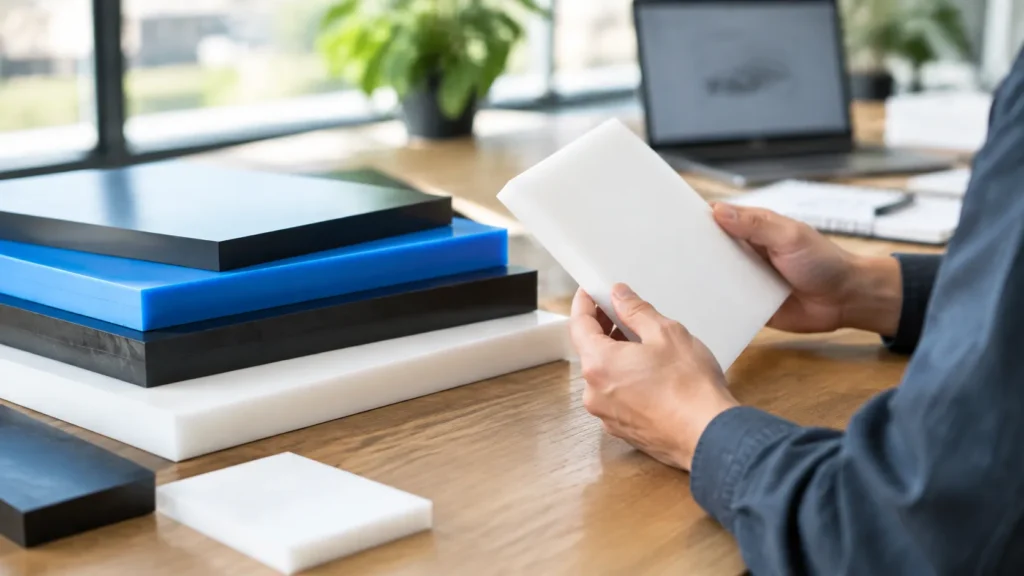
What is UHMWPE Board?
A UHMWPE board (Ultra-High Molecular Weight Polyethylene sheet) is a high-performance engineering thermoplastic engineered for the most demanding industrial environments. Recognized for its balance of toughness, ultra-low friction, and exceptional durability, UHMWPE outperforms conventional metals and standard plastics in extreme wear applications.
Definition and Molecular Characteristics
UHMWPE is a subset of thermoplastic polyethylene characterized by extremely long molecular chains. While standard High-Density Polyethylene (HDPE) has a molecular weight between 100,000 and 500,000 g/mol, UHMWPE features a molecular weight ranging from 3.5 to over 9 million g/mol.
- Microscopic Structure: The ultra-long molecular chains eliminate weak points within the polymer matrix, effectively transferring mechanical stress across the entire structure.
- Impact Dissipation: High molecular density prevents stress concentration, resulting in unmatched toughness even at sub-zero temperatures (down to -200°C).
- Non-Polar Surface: Strong carbon-hydrogen bonds create a chemically inert, non-stick surface that resists fluid bonding and chemical attack.
| Molecular Metric | Standard HDPE | Engineering UHMWPE |
|---|---|---|
| Molecular Weight | 100,000 – 500,000 g/mol | 3,500,000 – 9,200,000+ g/mol |
| Relative Abrasion Index | 100 (Baseline) | > 500 (5x higher wear life) |
| Water Absorption | < 0.01% | < 0.01% (Effectively Zero) |
Standard Manufacturing Processes and Sheet Forms
Due to its high molecular weight and zero melt flow index, UHMWPE cannot be processed using standard injection molding. Instead, specialized high-pressure techniques are used to ensure structural integrity and void-free material density:
- Compression Molding (Sintering): UHMWPE powder is placed into heavy steel molds, heated above its melting point under severe hydraulic pressure, and slowly cooled. This creates dense, stress-relieved UHMW sheets with optimal mechanical properties.
- Ram Extrusion: Continuous extrusion driven by a reciprocating hydraulic ram, producing continuous profiles, heavy wear strips, and continuous thick stock shapes.
- Skiving: Thin-gauge UHMWPE films and sheets shaved directly from compression-molded cylindrical billets.
Standard supply formats include:
Full Slabs and Panels: Typical thicknesses ranging from 1/8″ (3mm) to 4″ (100mm) in standard industrial sizes like 4×8 ft (1220x2440mm), 4×10 ft (1220x3050mm), and 2000x1000mm.
Cut-to-Size Strips and Liners: Pre-dimensioned panels ready for quick installation on conveyor tracks and chutes.
Precision Semi-Finished Blanks: Flat-milled stock optimized for tight-tolerance CNC machined parts and technical components.
Key Properties and Benefits of UHMWPE Boards
When selecting engineering materials for high-stress industrial environments, our UHMWPE boards provide an unmatched balance of mechanical strength and surface performance. Understanding why ultra-high molecular weight polyethylene stands out as the all-rounder in the engineering plastics industry comes down to four core physical advantages that outperform conventional metals and standard polymers.
| Property | Typical Value / Rating | Core Operational Benefit |
|---|---|---|
| Abrasion Resistance | Up to 10x higher than carbon steel | Prevents mechanical gouging and extends replacement cycles |
| Coefficient of Friction | 0.10 – 0.20 (Dry vs. Steel) | Eliminates surface sticking, bridging, and material drag |
| Impact Strength | No Break (Charpy Unnotched) | Absorbs severe shock loads without cracking or shattering |
| Water Absorption | < 0.01% | Dimensional stability in submerged or wet applications |
Exceptional Wear and Abrasion Resistance
The extremely long polymer chains in our UHMW sheets give the material its industry-leading sliding wear resistance. In high-abrasion environments involving aggregate, coal, ore, or grain, UHMWPE outlasts hardened steel, bronze, and common thermoplastics like HDPE and nylon.
- Extended equipment life: Reduces gouging and surface degradation in harsh bulk-flow setups.
- Lower maintenance overhead: Proven performance in high-wear parts like wear-resistant scrapers for conveyors and mechanical guides.
- Noise reduction: Dampens mechanical vibrations and system noise compared to metal-on-metal contact.
Low Coefficient of Friction and Self-Lubricating Properties
UHMWPE boards deliver a smooth, non-stick surface with a low friction coefficient comparable to PTFE, but with significantly higher load-bearing strength.
- Self-lubricating surface: Operates continuously in dry-running assemblies without requiring grease or oils.
- Zero bridging or caking: Prevents wet, sticky, or fine bulk powders from clinging to vessel walls.
- Energy savings: Reduces the motor torque and driving power required to move materials along sliding surfaces and wear strips.
High Impact Strength and Durability
Even under continuous, high-energy mechanical shocks, UHMWPE exhibits exceptional toughness. Unlike brittle plastics that shatter under heavy loads or thermal drops, UHMW sheets absorb kinetic energy by flexing slightly and returning to their original shape.
- Non-shattering reliability: Maintains high impact strength down to cryogenic temperatures (-200°C / -328°F).
- Deformation resistance: Absorbs heavy, repetitive drop impacts from rocks, scrap metal, and heavy freight without structural failure.
Chemical, Corrosion, and Zero Moisture Absorption
UHMWPE is chemically inert and completely hydrophobic, making it an ideal choice for outdoor, marine, and corrosive chemical environments.
- Near-zero water absorption (<0.01%): Will not swell, warp, rot, or freeze-bind in wet or marine conditions.
- Universal corrosion protection: 100% immune to rust, scale, and electrolytic corrosion.
- Broad chemical resistance: Resists concentrated acids, alkalis, organic solvents, and caustic washdown detergents across industrial facilities.
Common Material Grades of UHMWPE Boards
Not all operations require the same formulation. We manufacture and supply several distinct grades of UHMWPE board, each modified to deliver maximum performance across different thermal, mechanical, and electrical environments.
Virgin vs. Reprocessed (Recycled) UHMWPE
Choosing between virgin and reprocessed resin is typically a balance between purity requirements and project budget:
- Virgin UHMWPE: Produced from 100% unadulterated polymer resin. It offers the highest impact strength, superior wear life, and natural translucent-white coloring. It meets strict FDA, USDA, and 3-A dairy standards for direct food and pharmaceutical contact. Consult our detailed UHMWPE sheet buying guide to evaluate specific resin purity benchmarks for your facility.
- Reprocessed (Recycled) UHMWPE: Formulated by blending post-industrial virgin scrap with pure polymer. Usually supplied in black or utility green, it provides roughly 80% to 90% of virgin material’s physical properties at a lower price point. It excels in general non-food chute lining, marine dock fenders, and scrapers.
Self-Lubricating and Oil-Filled Grades
While standard UHMWPE already boasts an exceptionally slick surface, self-lubricating grades integrate liquid or solid additives directly into the polymer matrix during manufacturing:
- Dry Lubricant Additives (PTFE/Molybdenum Disulfide): Enhance dry-sliding performance, eliminate “slip-stick” chatter, and reduce heat buildup under heavy friction.
- Oil-Filled UHMWPE: Disperses continuous lubrication across the surface, dropping the dynamic friction coefficient by up to 50%. These boards significantly extend component lifespan in automated packaging lines and high-velocity systems—a key consideration when evaluating chain guide rail material selection under continuous cycle loads.
Anti-Static and Conductive (ESD) Grades
Standard plastics build up static charges from dry friction, creating risks in volatile environments. We formulate specialty carbon-enhanced boards to safely dissipate static electricity:
- Anti-Static Grade: Designed with surface resistivity ranging from $10^9$ to $10^{11}$ ohms/sq to eliminate static dust attraction and accidental discharge in high-speed conveying lines.
- Conductive (ESD) Grade: Infused with premium carbon black to achieve surface resistivity below $10^5$ ohms/sq. This grade is vital for explosive atmospheres (ATEX zones), grain silos, munitions handling, and electronics manufacturing facilities.
Specialized Filled Grades (Glass, Ceramic, and Borated)
For applications pushing past standard physical limits, filled composite grades deliver targeted mechanical enhancements:
| Grade Modification | Additive / Fill Type | Primary Benefit | Common Uses |
|---|---|---|---|
| Glass-Filled | Reinforced glass beads | Enhanced structural stiffness, thermal stability, and load-bearing capacity under constant pressure. | Structural guides, dynamic bushings, heavy wear plates. |
| Ceramic-Filled | High-hardness ceramic microspheres | Extreme cut and gouge resistance against sharp, highly abrasive slurries and minerals. | Dewatering elements, hydrocyclone liners, paper mill suction box covers. |
| Borated Grade | 1% to 5% Boron content | Exceptional attenuation and absorption of thermal neutrons. | Medical oncology walls, nuclear containment shields, radiation cask liners. |
Primary Industrial Applications of UHMWPE Boards
Thanks to their low friction coefficient, exceptional impact strength, and wear resistance, UHMWPE boards solve friction and impact bottlenecks across harsh industrial environments. We supply these heavy-duty sheets to replace failing metals, hardwoods, and standard plastics across several core industries.
Material Handling, Chute Liners, and Conveyor Components
Bulk solids such as coal, gravel, cement, and grain quickly erode traditional steel chutes and cause costly material hang-ups. Lining equipment with ultra high molecular weight polyethylene creates a slick, non-stick surface that promotes continuous material flow and prevents bridging.
- Chute and Hopper Liners: Eliminates rat-holing and reduces abrasive wear on steel bins.
- Conveyor Wear Strips: Low-friction guides protect belts, reduce motor drag, and extend machinery life.
- Chain Guides & Star Wheels: Precision-cut components lower operational noise and eliminate lubrication needs in modular conveyor parts and automated sortation setups.
Marine Fender Panels and Dock Bumpers
Marine infrastructure requires materials that withstand continuous pounding, UV exposure, and saltwater corrosion. UHMW sheets are standard facing pads on dock fenders, port pilings, and lock gates.
- Low Hull Friction: Protects vessel hulls during berthing by allowing ships to slide smoothly against fender faces without catching.
- Zero Water Absorption: Unlike wood or lower-grade polymers, UHMWPE will not swell, rot, or degrade from marine borers and freezing cycles.
Heavy Construction, Ground Protection, and Outrigger Pads
Heavy mobile machinery demands stable ground support under high loads. We fabricate heavy-duty outrigger pads and temporary roadway mats using thick UHMWPE boards to distribute extreme point loads safely.
- Crane Outrigger Pads: Delivers bend-resistant load distribution on soft or uneven terrain without cracking or splintering like timber.
- Temporary Ground Mats: Protects sensitive turf, prevents heavy haulers from sinking into deep mud, and withstands repeated vehicle traffic.
Food, Beverage, and Pharmaceutical Processing
Hygienic processing environments require non-toxic materials capable of handling frequent high-pressure washdowns and aggressive sanitizing agents. Virgin UHMW board grades meet strict FDA and USDA standards for direct food contact.
- Bottling and Canning Lines: Star wheels, feed screws, and sliding tracks guide containers smoothly at high speeds without scratching or scuffing.
- Sanitary Cutting Surfaces & Scrapers: Odorless, non-porous surfaces prevent bacterial buildup and resist chemical breakdown from industrial cleaners, establishing UHMWPE as one of our most dependable engineering plastic materials for sanitary packaging lines.
UHMWPE vs. Other Engineering Plastics
Choosing the correct material requires balancing mechanical properties, operating temperatures, and cost. While we manufacture and fabricate a complete portfolio of engineering plastic stock shapes, UHMWPE stands out whenever extreme impact, aggressive abrasion, and continuous sliding friction dominate the application.
| Property / Material | UHMWPE Board | HDPE Sheet | PTFE (Teflon) | Nylon (PA6/PA66) | Acetal (POM) |
|---|---|---|---|---|---|
| Molecular Weight | 3.5 to 9.2 Million g/mol | < 500,000 g/mol | High | Medium | Medium |
| Wear & Abrasion Resistance | Superior (Best in class) | Moderate | Low (Prone to creep) | High (Dry conditions) | High |
| Impact Strength | Extreme (No break) | Moderate to High | Low to Moderate | High | Moderate |
| Coefficient of Friction | Extremely Low (0.10–0.15) | Low (0.20–0.25) | Lowest (0.04–0.10) | Low to Medium (0.25–0.35) | Low (0.20–0.30) |
| Continuous Temp Range | -200°C to +80°C | -50°C to +80°C | -200°C to +260°C | -40°C to +100°C | -50°C to +100°C |
| Moisture Absorption | < 0.01% (Zero) | < 0.01% (Zero) | < 0.01% (Zero) | High (Up to 8–9%) | Low (0.2–0.8%) |
UHMWPE vs. HDPE: Key Differences
Both materials belong to the polyolefin family, but their molecular chain lengths create vast performance gaps:
- Molecular Weight: UHMWPE features molecular weights exceeding 3 to 9 million g/mol, compared to roughly 300,000 to 500,000 g/mol for standard high-density polyethylene.
- Abrasion & Wear: UHMWPE provides up to 10 times higher wear resistance than HDPE under heavy slurry, gravel, and bulk material flow.
- Impact Tolerance: UHMWPE does not shatter or yield under severe shock loads, even in cryogenic environments.
- Workability & Welding: While HDPE is simpler to hot-gas weld and thermoform (as detailed in our HDPE plastic sheet guide), UHMWPE board is the definitive choice for high-stress chute liners, wear plates, and harsh sliding contact.
UHMWPE vs. PTFE (Teflon)
PTFE delivers superior thermal and chemical resistance, but UHMWPE significantly outperforms it in structural integrity and mechanical wear:
- Wear and Gouging: UHMWPE board resists abrasive cutting and sliding gouges far better than soft PTFE.
- Deformation Under Load: PTFE is vulnerable to mechanical creep and cold flow under pressure; UHMWPE maintains dimensional integrity under heavy continuous loads.
- Operating Temperature: PTFE thrives up to 260°C (500°F), whereas standard UHMWPE is limited to continuous operating temperatures below 80°C (180°F).
- Economic Value: UHMWPE offers a substantially lower material cost, making it the practical choice for large-area surface linings.
UHMWPE vs. Nylon and Acetal (POM)
Nylon and Acetal serve as industry standards for precision mechanical parts, but UHMWPE takes precedence in wet, chemical, or unlubricated sliding settings:
- Moisture Absorption: Nylon absorbs ambient moisture and water, which causes dimensional swelling and loss of tensile strength. UHMWPE absorbs zero moisture, remaining 100% dimensionally stable in submerged or high-humidity operations.
- Friction & Caking: UHMWPE exhibits a lower dynamic friction coefficient than both Acetal and unfilled Nylon, eliminating sticking and bulk material hang-ups without requiring external lubricants.
- Rigidity vs. Impact: Acetal and Nylon deliver higher mechanical stiffness and tighter machining tolerances for rigid gears and threaded parts, whereas UHMWPE board absorbs punishing shock impacts and dampens continuous system noise.
Buyer’s Guide: How to Choose the Right UHMWPE Board
Selecting the optimal ultra high molecular weight polyethylene sheet requires matching material specifications to your exact operating conditions. We evaluate the key technical factors below to help you source the right grade, thickness, and profile for your project.
Evaluating Operating Environment and Temperature Limits
UHMWPE excels in extreme environments, but temperature thresholds dictate material longevity. While the material performs exceptionally well in cryogenic environments down to -200°C (-328°F), its continuous service temperature ceiling is approximately 80°C (180°F).
| Environmental Factor | Operating Condition | Recommended UHMWPE Board Grade |
|---|---|---|
| Cryogenic / Sub-Zero | Down to -200°C | Virgin UHMW sheet |
| Elevated Heat | 80°C to 104°C continuous | High-temperature stabilized grade |
| Outdoor / Solar Exposure | Direct UV radiation | Black UV-stabilized UHMWPE |
| Corrosive Chemicals | Strong acids/alkalis | Virgin natural UHMWPE |
For outdoor installations such as dock fenders or bulk handling liners, always specify UV-stabilized formulations to prevent surface embrittlement and discoloration over time.
Determining Load, Wear, and Thickness Requirements
Sheet thickness and molecular weight directly influence impact absorption and service life. When selecting thickness, calculate both the mechanical load and abrasive wear rates:
- Light-Duty Wear Strips (1/8″ to 1/4″ / 3mm – 6mm): Ideal for packaging lines, guide rails, and low-friction slider beds where impact is minimal.
- Medium-Duty Chute Liners (3/8″ to 3/4″ / 10mm – 20mm): Recommended for moderate aggregate handling, grain chutes, and hopper walls subject to continuous sliding abrasion.
- Heavy Impact Plates (1″ to 4″+ / 25mm – 100mm+): Essential for mining dump bodies, outrigger pads, and rock-box wear liners absorbing high-velocity drop impacts.
Higher molecular weight resins (5.0 to 9.0 million g/mol) yield the highest wear resistance and impact strength for severe-duty applications.
Custom CNC Machining, Cutting, and Dimensional Tolerances
UHMWPE behaves differently than standard plastics during fabrication due to its high thermal expansion coefficient and low melting point. Selecting the right cutting methods for UHMW sheets ensures precise edge finishes and prevents heat-induced warping.
Standard Machining Guidelines for UHMWPE:
├── Tooling: High-speed steel (HSS) or carbide with sharp positive rake angles
├── Cooling: Continuous air blast (avoid liquid coolants that require degreasing)
├── Feed Rates: High feed rates with moderate cutting speeds to clear chips fast
└── Tolerances: Standard commercial tolerance ±0.005″ to ±0.015″ (account for thermal expansion)
For complex CNC machined parts like wear tracks, bushings, or star wheels, ensure the stock sheet has undergone adequate stress-relieving cycles during manufacturing to maintain dimensional stability after cutting.
Regulatory Compliance and Certifications (FDA, USDA)
Direct contact with consumables or pharmaceutical products demands strict material traceability and compliance:
- FDA Compliance: Virgin natural (white) UHMWPE conforms to 21 CFR 177.1520 regulations for direct food contact.
- USDA & 3-A Dairy: Approved for sanitary meat, poultry, and dairy processing operations.
- EU Compliance: Standard sheets meet EU 10/2011 directives for plastics intended to come into contact with foodstuffs.
Never specify reprocessed or dark industrial grades for food, beverage, or sanitary conveyor systems, as they contain recycled material fractions that lack food-grade certification.
Key Sourcing Considerations When Choosing a Supplier
Selecting the right manufacturing partner for UHMWPE boards directly impacts product longevity, operational safety, and overall project costs. When evaluating suppliers, we prioritize verifiable material integrity, precision machining capabilities, and reliable supply chain logistics.
Material Purity and Quality Verification
Not all UHMWPE sheets deliver identical performance. Material molecular weight and resin purity dictate wear life and impact resistance. When sourcing boards, verify the following quality checkpoints:
- Molecular Weight Consistency: Ensure the resin meets true ultra-high molecular weight standards (typically 3.5 to 9.2 million g/mol) rather than lower-grade high-density polyethylene blends.
- Virgin Resin Verification: Request transparent documentation confirming 100% virgin polymer when applications require FDA compliance or maximum wear resistance.
- Testing and Certification: Reliable suppliers provide Mill Test Certificates (MTC), Certificates of Analysis (COA), and third-party test reports covering tensile strength, shore hardness, and wear indexes.
Custom Fabrication and Extrusion Capabilities
Standard sheet stock rarely fits complex assemblies out of the box. A capable supplier must provide comprehensive in-house conversion services to streamline installation.
Look for manufacturers equipped with multi-axis CNC routers, automated panel saws, and edge profiling tools. Partnering with a facility that specializes in precision plastic parts processing ensures your UHMWPE boards arrive pre-drilled, chamfered, and cut to exact CAD specifications with tight dimensional tolerances.
Pricing, Minimum Order Quantity (MOQ), and Lead Times
Balancing production schedules and procurement budgets requires full commercial transparency:
- Factory-Direct Pricing: Sourcing directly from the manufacturer eliminates intermediary markups on large sheet volumes and custom wear parts.
- Flexible MOQs: Evaluate whether the supplier supports small-batch custom prototyping alongside full container-load production runs.
- Predictable Lead Times: Ensure stable raw material inventory and mature logistics management to avoid production delays. You can readily submit specifications to request a quote and confirm current delivery schedules for both standard sheets and custom components.
Frequently Asked Questions About UHMWPE Boards
How do you differentiate between virgin and reprocessed UHMWPE?
Telling virgin and reprocessed material apart comes down to color, surface consistency, and performance certifications:
| Feature | Virgin UHMWPE Board | Reprocessed UHMWPE Board |
|---|---|---|
| Visual Appearance | Solid, consistent natural white, or clean custom pigments | Mostly black or dark green with slight color mottling |
| FDA / USDA Approval | Yes, certified for direct food contact | No, strictly for industrial use |
| Impact Strength | Maximum impact resistance (no break under standard tests) | Slightly reduced impact strength (approx. 10–20% lower) |
| Material Purity | 100% pure virgin polymer chains | Contains clean, recycled industrial regrind |
| Best Application | Food processing, medical, critical marine components | General chute liners, wear strips, guide rails |
Can UHMWPE boards be glued, painted, or welded?
Because UHMWPE has an extremely low surface energy and a non-stick profile, standard chemical bonding and surface treatments require specific methods:
- Gluing & Bonding: Standard adhesives, glues, and epoxies will not adhere to untreated UHMWPE. Bonding requires specialized surface treatment (such as corona, flame, or chemical etching) alongside specialized structural adhesives. In almost all industrial setups, mechanical fastening (bolts, countersunk screws, weld washers) is the preferred method.
- Painting: Standard paints will peel right off. Pigmentation must be added directly into the resin during the initial manufacturing stage rather than applied topically.
- Welding: Yes, UHMWPE can be joined using hot air welding, butt welding, or extrusion welding with compatible UHMWPE welding rods. When mechanical integration is critical, we often machine customized OEM plastic parts to avoid the need for secondary surface bonding.
What are the standard sizes and thicknesses available for UHMWPE sheets?
UHMWPE boards are manufactured in a wide range of standard sheet formats, with custom cut-to-size panels available for specific machinery requirements:
- Standard Sheet Dimensions:
- 4 ft x 8 ft (1220 mm x 2440 mm)
- 4 ft x 10 ft (1220 mm x 3050 mm)
- 5 ft x 10 ft (1500 mm x 3000 mm)
- 2000 mm x 1000 mm (Standard Metric)
- Standard Thickness Options:
- Thin Sheets / Strips: 1/8″ (3 mm), 3/16″ (5 mm), 1/4″ (6 mm)
- Medium Thickness: 3/8″ (10 mm), 1/2″ (12.7 mm), 3/4″ (20 mm), 1″ (25 mm)
- Heavy-Duty / Structural Blocks: 1-1/2″ (40 mm) up to 8″ (200 mm) or thicker upon request.