
How to Choose the Right Chain Guide Rail Material (UHMWPE vs Nylon vs HDPE vs PTFE)
Choosing the right chain guide rail material is essential for improving conveyor performance, reducing wear, and extending service life. The most commonly used materials include UHMWPE, Nylon (PA), HDPE, and PTFE, each offering different advantages depending on the application.
In this guide, we will compare these materials in terms of wear resistance, friction, strength, and cost to help you select the best option for your conveyor system.
What Is a Chain Guide Rail?
A chain guide rail (also known as conveyor guide rail or wear strip) is used to guide and support conveyor chains, reduce friction, and protect both the chain and conveyor structure from excessive wear. It is widely used in industries such as food processing, packaging, bottling, and logistics.
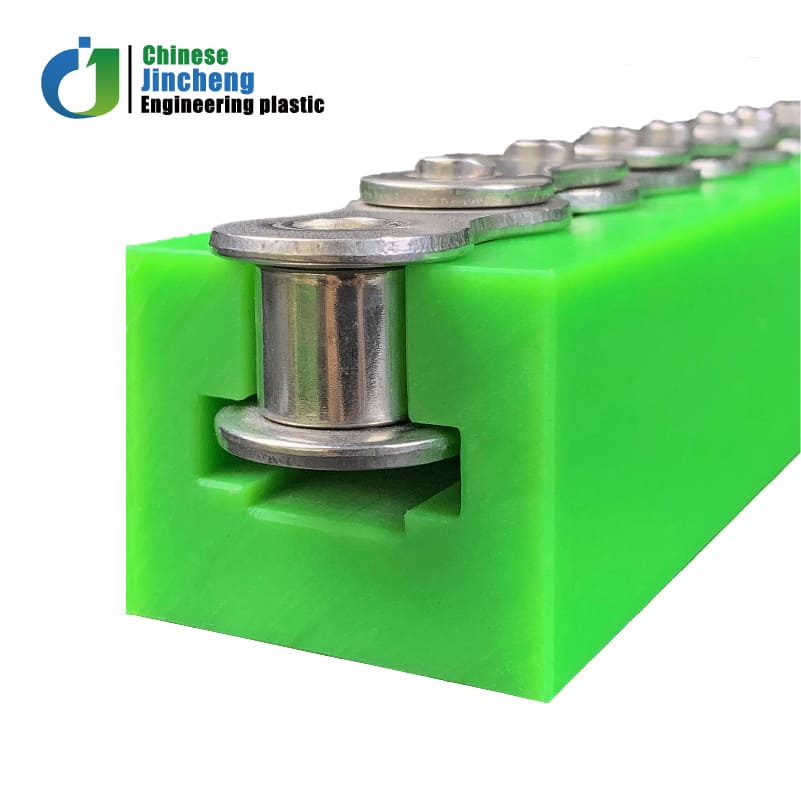
UHMWPE vs Nylon vs HDPE vs PTFE: Material Overview
1. UHMWPE (Ultra High Molecular Weight Polyethylene)
UHMWPE is the most widely used material for chain guide rails due to its excellent wear resistance and low friction.
Key Features:
- Extremely high wear resistance
- Very low friction coefficient
- Self-lubricating
- High impact strength
- Good chemical resistance
Best Applications:
- High-speed conveyors
- Food and beverage production lines
- Packaging systems
2. Nylon (PA)
Nylon is known for its high strength and rigidity, making it suitable for heavy-duty applications.
Key Features:
- High mechanical strength
- Good load-bearing capacity
- Better heat resistance than UHMWPE
Limitations:
- Higher friction than UHMWPE
- Moisture absorption affects stability
Best Applications:
- Heavy-load conveyors
- Industrial machinery parts
3. HDPE (High-Density Polyethylene)
HDPE is a cost-effective material used in light-duty conveyor systems.
Key Features:
- Lower cost
- Good chemical resistance
- Lightweight and easy to process
Limitations:
- Lower wear resistance
- Shorter service life
Best Applications:
- Light-duty conveyors
- Budget-sensitive projects
4. PTFE (Polytetrafluoroethylene)
PTFE is known for having the lowest friction coefficient among all plastics.
Key Features:
- Ultra-low friction coefficient
- Excellent chemical resistance
- High temperature resistance
- Non-stick surface
Limitations:
- Higher cost
- Lower wear resistance compared to UHMWPE
- Lower mechanical strength
Best Applications:
- High-temperature environments
- Chemical processing
- Applications requiring minimal friction
Key Factors When Choosing Chain Guide Rail Material
1. Wear Resistance
For long-term use and high abrasion environments, UHMWPE is the best choice due to its superior wear resistance.
2. Friction Coefficient
If reducing friction and noise is critical, PTFE offers the lowest friction, followed by UHMWPE.
3. Load Capacity
For heavy loads and structural strength, Nylon (PA) performs better than other materials.
4. Cost Consideration
- Low budget → HDPE
- Balanced performance → UHMWPE
- High-performance special applications → PTFE
5. Working Environment
- Food industry → Food-grade UHMWPE
- High humidity → Avoid Nylon
- Chemical exposure → PTFE or UHMWPE
- High temperature → PTFE
Quick Comparison Table
| Property | UHMWPE | Nylon (PA) | HDPE | PTFE |
|---|---|---|---|---|
| Wear Resistance | Excellent | Good | Moderate | Moderate |
| Friction | Very Low | Medium | Medium | Ultra Low |
| Strength | Medium | High | Low | Low |
| Temperature Resistance | Medium | High | Medium | Very High |
| Cost | Medium | Medium | Low | High |
| Chemical Resistance | Good | Moderate | Good | Excellent |
Which Material Should You Choose?
- Choose UHMWPE for most conveyor systems due to its durability and low friction
- Choose Nylon for high-load and structural applications
- Choose HDPE for low-cost, light-duty systems
- Choose PTFE for high-temperature or ultra-low friction requirements
For most industrial conveyor applications, UHMWPE remains the best overall choice.
Conclusion
Selecting the right chain guide rail material can significantly improve conveyor efficiency, reduce maintenance costs, and extend equipment lifespan. By understanding the differences between UHMWPE, Nylon, HDPE, and PTFE, you can make a more informed decision based on your application needs.
If you are looking for customized chain guide rails or need help selecting the right material, working with a professional supplier is highly recommended.